


16 Oct 2026
Historically, September has been a difficult month for high yield. In fact, it has been the weakest month of the year on data reaching back to 1998.1 Interestingly, that weakness has been particularly pronounced in years like this, when the US has held midterm elections. Meanwhile, credit spreads are tight (although, as we recently argued they are a long way from being too tight).
September has been the weakest calendar month for high yield
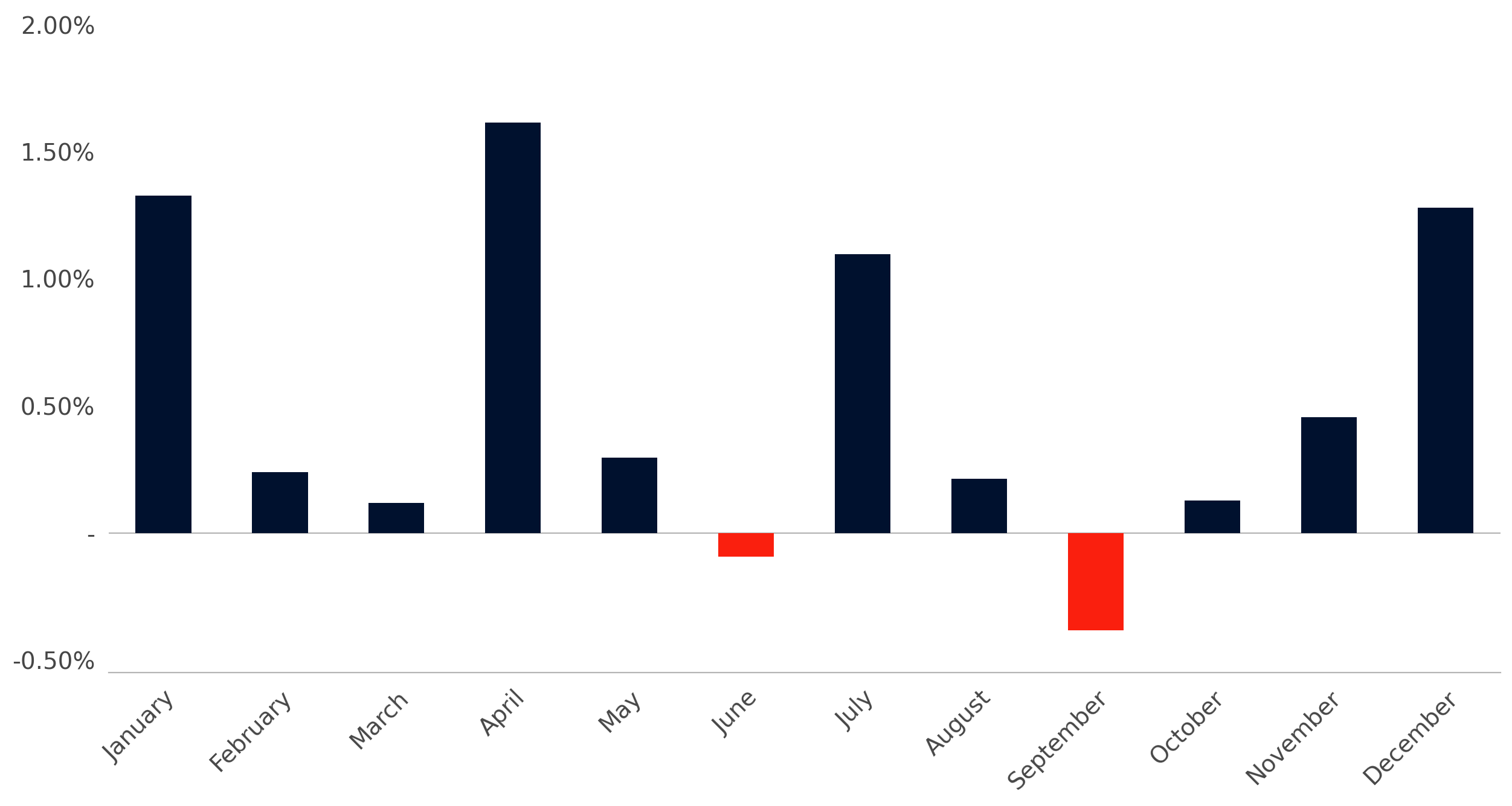
Source: FactSet. Data from January 1998 to December 2024.
On the other hand, we like the companies whose bonds we own and we like the yields they offer. The broader backdrop, meanwhile, looks healthy. The second-quarter earnings season has been robust. The proportion of companies in the S&P 500 reporting positive surprises on earnings is at its highest since 20212. The manufacturing and services ISM indices are both firmly in expansionary territory3.
So what to do?
In Artemis Funds (Lux) – Short-Dated Global High Yield Bond, cash keeps being returned to us through coupons, calls and as bonds mature. Through September, we can simply slow the pace at which we reinvest that cash – or redirect it into a handful of favoured, lower-beta bonds. And, of course, cash will continue to arrive. We can then deploy it if prices weaken.
In Artemis Funds (Lux) – Global High Yield Opportunities, a recent change to the mandate allowing us to vary its net market exposure gives us another way to anticipate seasonality. We don’t want to sell our high-conviction credit holdings – and forgo their income – simply because September has historically been weak. Instead, we can subtract some of the fund's the broad exposure to the high-yield market by buying protection (on the iTraxx Europe Crossover, a liquid hedge on European high-yield bonds and through a small, tech-specific credit hedge). Although we pay a modest amount for that protection, we retain the income our bonds pay. We think that is more attractive than simply selling bonds.
This is tactical positioning. It is not a forecast that September will necessarily be weak. Nor is it a bearish call on high yield. The protection we have taken out is subject to change and, as things stand, we don't envision keeping it beyond the end of September.
We still like high-yield bonds. Equally, we are making sure that, if seasonal weakness does present us with a better entry price, we are ready to take advantage.
1. FactSet, ICE BofA Global High Yield Total Return, 1998-2024. Average return in September -0.38% vs -0.40% in midterm election years.
2. Financial Times, 2 August 2026, America’s biggest companies report ‘rock solid’ profits as consumers face higher costs
3. Institute for Supply Management - Services PMI at 54.1% July 2026 ISM Services PMI Report and Manufacturing PMI at 54.6% August 2026 ISM Manufacturing PMI Report
FOR PROFESSIONAL INVESTORS AND/OR QUALIFIED INVESTORS AND/OR FINANCIAL INTERMEDIARIES ONLY. NOT FOR USE WITH OR BY PRIVATE INVESTORS.
CAPITAL AT RISK. All financial investments involve taking risk and the value of your investment may go down as well as up. This means your investment is not guaranteed and you may not get back as much as you put in. Any income from the investment is also likely to vary and cannot be guaranteed.
This is a marketing communication. Before making any final investment decisions, and to understand the investment risks involved, refer to the fund prospectus (or in the case of investment trusts, Investor Disclosure Document and Articles of Association), available in English, and KIID/KID, available in English and in your local language depending on local country registration, available in the literature library.