

05 Nov 2026
With markets now pricing further interest rate hikes, the outlook for money market solutions is becoming more favourable. As higher yields make cash increasingly attractive, portfolio manager Tim Foster highlights why changing rate expectations are also reinforcing the importance of active maturity management, reinvestment flexibility and credit discipline.
With the outlook for interest rates shifting higher, investors are reassessing the relative attractiveness of cash and longer duration fixed income assets. Global government bond yields have continued to rise, with explanations ranging from fiscal concerns and growing AI funding requirements to geopolitical uncertainty. However, we believe the main drivers are more fundamental, with resilient growth and persistent inflation pushing central bank rate expectations higher.
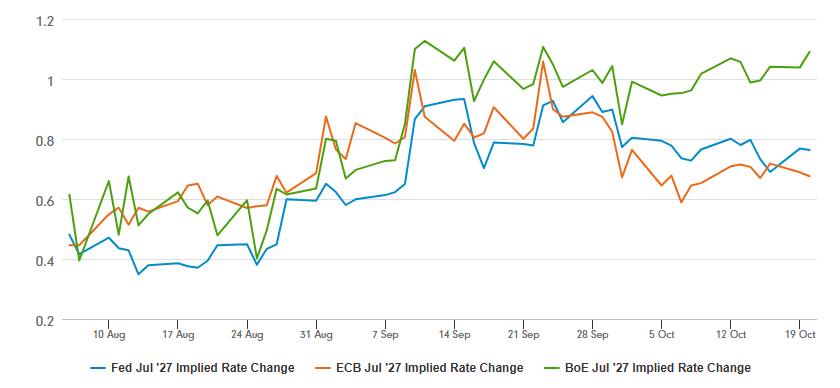
At the start of the year, markets were pricing interest rate cuts from the US Federal Reserve, European Central Bank and Bank of England. Three to four hikes are now anticipated by next summer and this reversal has made cash increasingly attractive relative to risk assets facing a range of uncertainties.
For money market investors, the changing environment reinforces the importance of active management. Adjusting a fund's weighted average maturity (WAM), maintaining appropriate liquidity levels and applying rigorous credit research can help navigate changing rate expectations, while keeping capital preservation and liquidity at the forefront.
There are three important considerations in the current environment.
1. Liquidity continues to offer an attractive yield
Higher interest rates reduce the income cost of maintaining liquidity. Investors can retain access to their cash while earning yields that are still attractive relative to risk assets. This is particularly valuable during periods of uncertainty, when longer duration assets can experience greater volatility.
2. Reinvestment flexibility becomes more valuable
Active management of the maturity budget is key as rates move higher, as shorter maturities can provide access to higher reinvestment rates, while floating rate securities can adjust their interest payments more quickly to reflect rising rates. There is also the opportunity to lock in longer fixed rates as curves steepen when markets price a more aggressive policy path.
3. Credit and liquidity discipline remain essential
Fundamental credit analysis, issuer diversification and careful management of daily and weekly liquidity remain essential, particularly as markets adjust to higher interest rates. Rather than reaching for incremental spread, our focus remains on preserving capital and maintaining liquidity while identifying opportunities to generate attractive returns.
Markets may be underestimating how far rates could rise
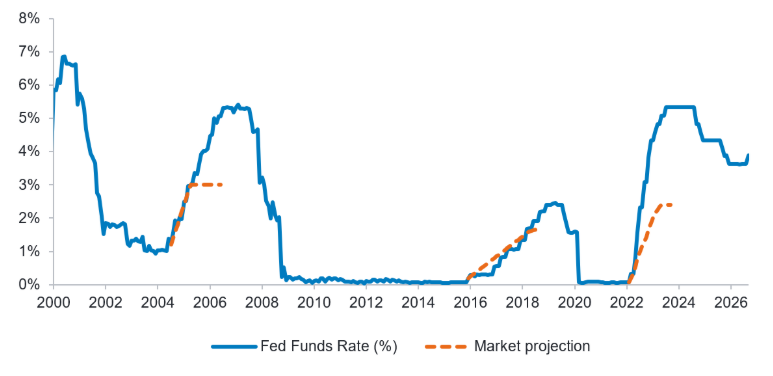
Historical hiking cycles vs expectations
Source: Fidelity International, Bloomberg. October 2026.
Looking back at previous interest rate hiking cycles, markets have consistently underestimated how high policy rates would ultimately rise. This is an important consideration as expectations for the current cycle continue to evolve.
Global growth has remained relatively resilient, supported in part by unprecedented investment in AI infrastructure. This has given central banks greater scope to consider raising rates even while inflation remains above target.
However, the outlook is far from certain. Any deterioration in growth, or an unexpected resolution to the energy pressures associated with ongoing conflicts, could prompt markets to scale back their expectations for further tightening.
For now, however, market pricing continues to point towards a higher for longer interest rate environment.
During a hiking cycle, money market funds would typically reduce their WAM to allow portfolio yields to adjust more quickly to rising rates. However, the scale and speed of recent changes in market expectations have also created opportunities to take a more flexible approach.
Where we believe markets have priced an overly aggressive path for interest rates, we may extend WAM to capture attractive fixed rates. Conversely, where we see scope for further upside surprises, we prefer to maintain shorter maturities to preserve reinvestment flexibility.
Evolution of market implied rate changes by July 2027
Source: Fidelity International, Bloomberg. 9 October 2026.
This approach is reflected in our positioning across the three main currencies, where differences in central bank policy and economic conditions are creating distinct opportunities.
In our US dollar funds, we have reduced WAM to around 40 days.
The Federal Reserve's new regime under Kevin Warsh has brought a significant reduction in forward guidance, contributing to greater market volatility. We also believe markets could move relatively quickly to price a faster pace of interest rate hikes should economic conditions warrant it.
Against this uncertainty, we prefer to maintain a shorter maturity profile, allowing the flexibility to respond more readily to further changes in rate expectations.
In our euro funds, we are maintaining a slightly longer WAM of around 45 days.
Europe is particularly exposed to energy-related inflation pressures, including disruptions to refined product supply chains and the need to rebuild energy inventories. However, the European Central Bank continues to focus on the potential second round effects of inflation and the impact of higher energy costs on demand.
Financial conditions have also tightened amid renewed fiscal concerns, with peripheral government bond spreads widening sharply. This may reduce the immediate need for further rate hikes. We therefore see scope to maintain a somewhat longer maturity profile in the near-term.
In our sterling funds, we have also maintained a longer maturity bias, with WAM of up to 45 days, taking advantage of the steepness of the money market curve.
Like the European Central Bank, the Bank of England has adopted a scenario-based approach to assessing the impact of the energy price shock. We believe markets have been pricing an overly aggressive path for UK interest rates in the near-term and expect the Bank to be reluctant to raise rates more frequently than once a quarter.
UK gilt yields also remain the highest among G7 countries, contributing to tighter financial conditions and potentially reducing the need for more aggressive monetary tightening.
Food price inflation has been surprisingly subdued in 2026, despite supply chain disruptions affecting key agricultural inputs, including fertilisers, following the Iran conflict. This has helped contain headline inflation even as underlying price pressures have remained persistent.
Looking ahead to 2027, we see growing risks of higher food prices. The prospect of a strong El Niño event, elevated energy and fertiliser costs, and the effects of a hot summer across much of 2026 could all contribute to renewed inflationary pressure.
Markets are beginning to recognise this as a potential source of upside inflation surprises. The key question for central banks will be whether higher food prices remain a temporary shock or begin to feed through into broader inflation expectations and wage pressures.
If these pressures persist, central banks may need to keep interest rates higher for longer, supporting yields on money market funds. Combined with the flexibility to respond to changing market conditions, this should help sustain the appeal of money market funds for investors seeking attractive income while maintaining liquidity and capital preservation as key priorities.
Important information
This information must not be reproduced or circulated without prior permission. This information does not constitute investment advice unless specifically agreed in a formal communication. Fidelity International refers to the group of companies which form the global investment management organisation that provides information on products and services in designated jurisdictions outside of North America. Fidelity, Fidelity International, the Fidelity International logo and F symbol are registered trademarks of FIL Limited.
This communication is not directed at, and must not be acted upon by persons inside the United States and is otherwise only directed at persons residing in jurisdictions where the relevant funds are authorised for distribution or where no such authorisation is required.
We recommend that you obtain detailed information before taking any investment decision. Investments should be made on the basis of the current prospectus and the KID (key information document) or KIID (key investor information document), as applicable. These documents, the current annual and semi-annual reports as well as information on investor rights are available in the languages and on the websites indicated below.
Austria: Prospectus and KID in English/German and Complaints policy in German on www.fidelity.at. Issued by FIL Investment Management (Luxembourg) S.à r.l., authorised and supervised by the CSSF (Commission de Surveillance du Secteur Financier).
Belgium: Prospectus, KID and Complaints policy in French/Dutch on www.fidelity.be. Issued by FIL Investment Management (Luxembourg) S.à r.l., authorised and supervised by the CSSF (Commission de Surveillance du Secteur Financier).
Croatia: Prospectus in English, KID and Complaints policy in Croatian on www.fidelity.hr. Issued by FIL Investment Management (Luxembourg) S.à r.l., authorised and supervised by the CSSF (Commission de Surveillance du Secteur Financier).
Czech Republic: Prospectus and KID in English/Czech and Complaints policy in Czech on www.fidelity.cz. Issued by FIL Investment Management (Luxembourg) S.à r.l., authorised and supervised by the CSSF (Commission de Surveillance du Secteur Financier).
Denmark: Prospectus in English, KID in English/Danish and Complaints policy in Danish on www.fidelity.dk. Issued by FIL Investment Management (Luxembourg) S.à r.l., authorised and supervised by the CSSF (Commission de Surveillance du Secteur Financier).
Finland: Prospectus in English, KID in English/Finnish and Complaints policy in Finnish on www.fidelity.fi. Issued by FIL Investment Management (Luxembourg) S.à r.l., authorised and supervised by the CSSF (Commission de Surveillance du Secteur Financier).
France: Prospectus, KID and Complaints policy in French on www.fidelity.fr. This document is available in French upon request. If you do not wish to receive documents in English dedicated to Professional, please contact your Fidelity contact. Issued in France by FIL Gestion, authorised and supervised by the AMF (Autorité des Marchés Financiers) N°GP03-004, 21 Avenue Kléber, 75116 Paris.
Germany: Prospectus in English, KID and Complaints policy in German on www.fidelity.de/anlegerinformationen, www.fidelity.de/beschwerdemanagement/ and www.fidelity.lu/complaints-handling-policy. Any performance disclosure is not compliant with German regulations regarding retail clients and must therefore not be handed out to these. Issued for German Wholesale clients by FIL Investments Services GmbH / for German Pension clients by FIL Finance Services GmbH (Kastanienhöhe 1, 61476 Kronberg im Taunus). Issued for German Institutional clients by FIL Investment Management (Luxembourg) S.à r.l., 2a, rue Albert Borschette BP 2174 L-1021 Luxembourg.
Hungary: Prospectus in English, KID in English/Hungarian and Complaints policy in Hungarian on www.fidelity.co.hu. Issued by FIL Investment Management (Luxembourg) S.à r.l., authorised and supervised by the CSSF (Commission de Surveillance du Secteur Financier).
Ireland: Prospectus, KID and Complaints policy in English on www.fidelity.ie. Issued by FIL Investment Management (Luxembourg) S.à r.l., authorised and supervised by the CSSF (Commission de Surveillance du Secteur Financier).
Italy: Prospectus, KID and Complaints policy in Italian on www.fidelity-italia.it. Information is also available in Italian at Consob. Issued by FIL Investment Management (Luxembourg) S.à r.l., authorised and supervised by the CSSF (Commission de Surveillance du Secteur Financier).
Liechtenstein: Prospectus, KID and Complaints policy in English/German on www.fidelity.li. Issued by FIL Investment Management (Luxembourg) S.à r.l., authorised and supervised by the CSSF (Commission de Surveillance du Secteur Financier).
Luxembourg: Prospectus and KID in English/French/German and Complaints policy in English on www.fidelity.lu. Issued by FIL Investment Management (Luxembourg) S.à r.l., authorised and supervised by the CSSF (Commission de Surveillance du Secteur Financier).
Malta: Prospectus, KID and Complaints policy in English on www.fidelity.com.mt and from BOV Asset Management Limited (which is licensed by the Malta Financial Services Authority). The Fund is promoted in Malta by BOV Asset Management Limited in terms of the EU UCITS Directive; the Investment Services Act, Chapter 370 of the Laws of Malta; and the Investment Services Act (Marketing of UCITS) Regulation, Subsidiary Legislation 370.18 of the Laws of Malta. Issued by FIL Investment Management (Luxembourg) S.à r.l., authorised and supervised by the CSSF (Commission de Surveillance du Secteur Financier).
Netherlands: Prospectus, KID and Complaints policy in Dutch on www.fidelity.nl. Issued by FIL Investment Management (Luxembourg) S.à r.l., authorised and supervised by the CSSF (Commission de Surveillance du Secteur Financier).
Norway: Prospectus in English, KID in English/Norwegian and Complaints policy in Norwegian on www.fidelity.no. Issued by FIL Investment Management (Luxembourg) S.à r.l., authorised and supervised by the CSSF (Commission de Surveillance du Secteur Financier).
Poland: Prospectus, KID, Additional Information for Investors in English/Polish and Complaints policy in Polish on www.fidelity.pl and from the fund’s representative office in Poland. This material does not constitute a recommendation within the meaning of the Regulation of the Polish Minister of Finance Regarding Information Constituting Recommendations Concerning Financial Instruments or Issuers Thereof dated October 19, 2005. No statements or representations made in this document are legally binding on Fidelity or the recipient and not constitute an offer within the meaning of the Polish Civil Code Act of 23 April 1964. Issued by FIL Investment Management (Luxembourg) S.à r.l., authorised and supervised by the CSSF (Commission de Surveillance du Secteur Financier).
Portugal: Prospectus in English, KID and Complaints policy in Portuguese on www.fidelity.pt. Fidelity Funds is registered with the CMVM and the legal documents can be obtained from locally authorised distributors. Issued by FIL Investment Management (Luxembourg) S.à r.l., authorised and supervised by the CSSF (Commission de Surveillance du Secteur Financier).
Romania: Prospectus in English, KID in English/Romanian and Complaints policy in Romanian on www.fidelity.ro. Issued by FIL Investment Management (Luxembourg) S.à r.l., authorised and supervised by the CSSF (Commission de Surveillance du Secteur Financier).
Slovakia: Prospectus in English, KID in English/Slovakian and Complaints policy in Slovakian on www.fidelity.sk. Issued by FIL Investment Management (Luxembourg) S.à r.l., authorised and supervised by the CSSF (Commission de Surveillance du Secteur Financier).
Spain: Prospectus and KID in English/Spanish and Complaints policy in Spanish on www.fondosfidelity.es. The distributing and depositary entities are, respectively, FIL Investment Management (Luxembourg) S.à r.l. and Brown Brothers Harriman (Luxembourg) S.C.A. Fidelity Funds and FAST are registered for marketing in Spain in the register of Foreign Collective Investment Undertakings of the CNMV under registration numbers 124 and 649 respectively, where detailed information on the local distributors can be obtained.
Issued by FIL Investment Management (Luxembourg) S.à r.l., authorised and supervised by the CSSF (Commission de Surveillance du Secteur Financier)
Sweden: Prospectus in English, KID in English/Swedish and Complaints policy in Swedish on www.fidelity.se. Issued by FIL Investment Management (Luxembourg) S.à r.l., authorised and supervised by the CSSF (Commission de Surveillance du Secteur Financier).
Switzerland: Prospectus and KID in English/German/French and Complaints policy in German/English on www.fidelity.ch and from the representative and paying agent in Switzerland, BNP Paribas, Paris, succursale de Zurich, Selnaustrasse 16, 8002 Zurich. Fidelity undertakes the financial services of purchasing and/or selling financial instruments within the meaning of the Financial Services Act (FinSA). Fidelity is not required to assess the appropriateness and suitability under FinSA. The information provided constitutes an advertisement. Issued by FIL Investment Switzerland AG.
UK: The Key Investor Information Document (KIID) is available in English and can be obtained from our website at www.fidelityinternational.com. The Prospectus may also be obtained from Fidelity. Issued by FIL Pensions Management. Authorised and regulated by the Financial Conduct Authority.
GCT261033EUR
