

15 Apr 2026
The outlook for health care is improving, fueled by innovation across several key subsectors.
Health care is firmly in a new era of innovation, driven by ongoing advancements across biotech, life science tools and diagnostics, and managed care and distributors. These developments are steadily improving the sector’s prospects, creating compelling opportunities for investors. As it emerges from post‑pandemic challenges, and despite policy uncertainty and cost pressures, the overall outlook for health care looks increasingly favorable.
"Investors in this space will need to rely on rigorous research and a deep understanding of the scientific developments shaping innovation."
Sal Rais, Portfolio Manager
During broad market and technology sector sell‑offs, health care stocks historically have provided countercyclical exposure, typically offering more attractive valuations compared with the overall market. However, the sector’s inherent complexity makes thoughtful stock selection more important than ever. Investors in this space will need to rely on rigorous research and a deep understanding of the scientific developments shaping innovation.
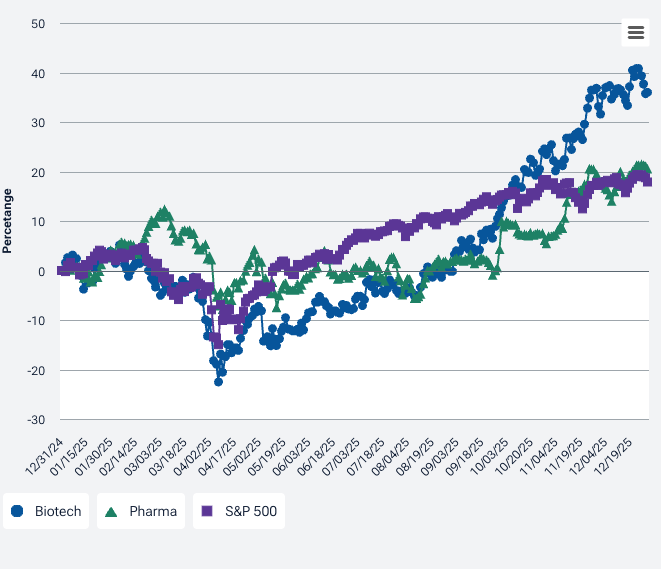
As of December 31, 2025.
Past performance is not a guarantee or a reliable indicator of future performance. Index performance is for illustrative purposes only and is not indicative of any specific investment. Investors cannot invest directly in an index.
Biotech is represented by the S&P Biotechnology Select Industry Index. Pharma is represented by the NYSE Arca Pharmaceutical Index. S&P 500 is the Standard & Poor’s 500 Stock Index.
Source: T. Rowe Price calculations using data from FactSet Research Systems Inc. All rights reserved.
For office use only: 202602-5200525
Direct engagement with company management can also provide valuable insight into the forces shaping the health care sector. At the recent Buy-Side Healthcare CEO Summit in Q4 2025, our team met with industry leaders to discuss the latest trends and challenges. This white paper explores key themes from those discussions and examines what may lie ahead for the sector.
Medicines are among the most cost-effective interventions in health care. However, biotech and pharmaceutical companies face considerable research and development risks when developing new medicines, with only 10% to 15% of drugs ultimately reaching the market. Scientific progress has led to a deeper understanding of different diseases, enabling researchers to identify novel classes of medicines that can treat disorders more effectively.
At the same time, many leading large-cap pharmaceutical companies are entering the most significant patent expiry period the space has ever seen, with around USD 300 billion in mature drugs due to come off patent by 2030.1 This has accelerated mergers and acquisitions (M&A) across small- and mid-cap biotech companies throughout 2025 (see Figure 3), with around USD 138 billion in deal activity during the year.2 These developments have allowed biotech to meaningfully outperform after several years of lackluster performance.3
(Fig. 2) M&A accelerated last year ahead of major patent expiry period
(Fig. 3)
Innovation drives progress across key therapeutic biotech categories
(Fig. 4)
| Obesity |
|
|---|---|
| Alzheimer's disease |
|
| Cell therapy and genetic medicines |
|
(Fig. 5) Annual estimated growth in total U.S. population age 75+
YoY = Year-over-Year. E = Estimates by T. Rowe Price. 2023 data source: Annual Estimates of the Resident Population by Single Year of Age and Sex for the United States: April 1, 2020 to July 1, 2023 (NC_EST2023_SYASEXN), U.S. Census Bureau, Population Division. Release date: June 2024. The figures are developed from a base that integrates the 2020 Census, Vintage 2020 estimates, and 2020 Demographic Analysis estimates, adding births to, subtracting deaths from, and adding net migration to, the April 1, 2020 estimates base. For additional methodology and/or current census data, visit census.gov.
2024–2034 data source: Estimates by T. Rowe Price using Census Bureau data and other historical data. See end disclosure on economic and demographic estimates for additional information.
Actual future outcomes may differ materially from estimates and data shown is subject to change.
For office use only: 202602-5200525
We expect this trend to continue. We believe there is opportunity in small- and mid‑cap biotech companies relative to large‑cap pharmaceuticals and in therapeutics such as obesity, Alzheimer’s disease, and cell therapies/genetic medicines. Outcomes for biotech companies are largely binary, with significant dispersion. This requires deep scientific diligence of each company’s drug development pipeline.
We believe many companies in the life sciences and diagnostics subsectors are well positioned to benefit indirectly from the potential wave of new medicines described in Figure 4. This space is filled with attractive-earnings per share potential “compounder” companies that have fallen out of favor over the last three years, as well as smaller innovative businesses in emerging diagnostic and therapeutic areas.
A key advantage of the life science tools and diagnostics space is that investors do not have to look for the biotech or drug class “winner.” The drug development innovation cycle, combined with aging demographics, is resulting in improving treatments, increased research activity, and higher prescription drug volumes. Together, these factors point to an accelerating organic growth trajectory in the near term and an industry that could grow well above gross domestic product over the long term.
After the spate of research activity and funding during the pandemic, the life sciences sector experienced a cyclical downturn for the first time, sparking investor confusion and uncertainty. This was coupled with turmoil in the academic and government end market. The pharmaceutical sector has also faced drug‑pricing uncertainty and the implementation of tariffs, which have weighed on research and new project activity.
In 2026 and beyond, however, the outlook looks positive. There is still significant support for academic and government research spending, while many pharmaceutical companies have made agreements with the U.S. administration on future drug pricing and tariffs. This should allow them to get back to business as usual and could even act as a tailwind to the life sciences sector as new facilities and production lines are brought online in the U.S. These agreements have instilled more confidence in the market overall, which has driven biotech valuations higher over the last 12 months. Increased biotech funding activity bodes well for research and development spending.
“...bioproduction is benefiting from the wave of new medicines...”
Mike Signore, Portfolio Manager
In life science tools and diagnostics, bioproduction (the use of living cells to product commercial products) is benefiting from the wave of new medicines—so companies in this space should be well positioned. In our view, an extended investment horizon is necessary to enable investors to fully capture the current tailwinds.
Life science tools and diagnostics sector to benefit from innovation surge as patent cliff approaches
(Fig. 6)
| Innovation continues, despite muted organic growth |
|
|---|---|
| Biosimilars: Loss of patent to boost drug volumes |
|
| China's biotech sector is growing |
|
| Biotech funding and M&A |
|
After a few tough years, we think the managed‑care space is filled with stocks that are underearning and trading at attractive relative valuations. We see opportunities across large-, mid-, and small-cap health insurers for outsized earnings growth as secular tailwinds continue and policy headwinds abate.
From 2015 through 2023, managed care was one of the best-performing S&P healthcare subsectors, with enrollment growth fueled by the Affordable Care Act (ACA), an aging population, pricing power, and government policy stability. However, over the last two years, managed‑care stocks have significantly underperformed.4 Health insurers faced earnings pressure following post-pandemic utilization and major government program changes across Medicare Advantage, Medicaid, and the ACA.
As a result, industry margins for Medicare Advantage, Medicaid, and the ACA exchanges are now breakeven or negative, and sector valuations are below historical long-term averages as the market remains unconvinced of a return to margin stability.
Investing in these stocks now requires a contrarian mindset. In our view, while it is impossible to predict the exact timing of margin improvement, break‑even or negative margins are not sustainable for this industry over the long term.
“Amid the increased complexity across biotech innovation, the specialty drug supply chain is a key area of focus.”
Maggie Brady, Investment Analyst
We believe the focus should be on the core tenets that make managed‑care stocks attractive, and those remain intact. Health insurers have typically been high return on equity businesses with pricing power and an ability to redesign benefits on an annual basis. They benefit from increasing health care spend on drugs and procedures and Americans’ need to purchase health insurance. We also think the long-term structural shift toward private sector benefit administration and away from government‑administered plans will continue.
The rise of specialty drug distribution
Amid the increased complexity across biotech innovation, the specialty drug supply chain is a key area of focus. We think the outlook is compelling for companies with market‑leading positions in specialty oncology drug distribution and dispensing.
We believe this dynamic should continue as pharmaceutical companies accelerate their focus on the specialty drug pipeline.
Specialty drugs are incredibly complex, requiring highly specific manufacturing and handling processes, intensive patient monitoring, and careful dispensing. These drugs also need to be distributed and dispensed to high-acuity patients at speed. The innovation presents a compelling opportunity for health care services companies that have market‑leading positions in specialty drug distribution via scaled physical infrastructure, manufacturer partnerships, and physician relationships.
Within specialty drug distribution, oncology is an area where drug spend is growing fast. In addition to the innovation, the patent cliff for oncology biologics and branded orals should provide an incremental tailwind to key players focused on this area of the supply chain.
The health care sector’s next era will likely be defined by ongoing innovation and evolving market dynamics. While each key subsector faces distinct challenges and uncertainties, these are balanced by differentiated opportunities shaped by structural trends and scientific advances. In our view, a thoughtful, active approach is essential for navigating this complex health care landscape—working to pinpoint the standout companies while keeping track of emerging risks and pressure points.
Source information for Fig. 2
Investment Analyst
Co-Portfolio Manager
Investment Analyst


