


21 Jul 2026
Private markets are entering a new phase.
After a period dominated by rising valuations, cheap capital and abundant liquidity, the focus is shifting towards fundamentals, income and disciplined investment selection.
Our latest Private Markets House View suggests a more selective, dispersion-driven environment, where opportunities remain compelling — but are increasingly concentrated in high-quality assets, resilient cash flows and structural growth themes.
The starting point is a global economy that is slowing but resilient. Growth remains intact across major economies, with the US expected to expand by around 2.2% in 2026, China around 4.8% and India close to 6.8% [1].
However, inflation pressures, geopolitical risks and diverging policy paths continue to drive volatility. Recent tensions in energy markets have reinforced uncertainty, even as easing monetary conditions begin to offer some support.
In this environment, private markets are playing a critical role in portfolios as a source of resilient income and long-term structural exposure.
Private equity deal activity softened at the start of 2026. US deal value fell 18.3% quarter-on-quarter to US$260.2 billion, while European deal value declined 22.5% [2].
Yet headline numbers mask a more nuanced picture [3]:
Add-on acquisitions now account for 71.4% of European buyouts, a decade high
Valuations globally remain firm at 12.6x EV/EBITDA - signalling continued support for high-quality assets
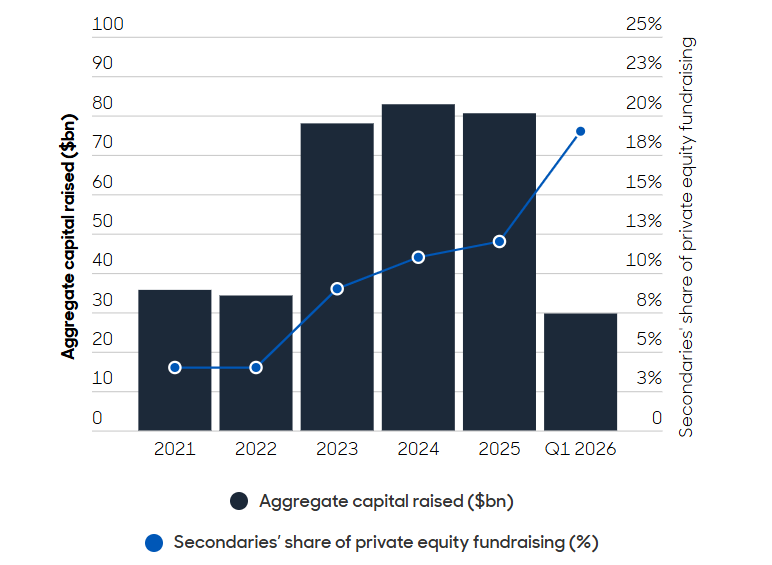
Fundraising dynamics are shifting, with secondaries accounting for around 19% of first quarter (Q1) activity (see Chart 1).
Chart 1: Private equity fundraising vs secondaries share over time
Source: Preqin, May 2026.
In short, the market is becoming more selective. Capital is concentrating in high-quality assets, often accessed through bolt-on strategies rather than large headline-grabbing deals.
Crucially, returns are becoming less reliant on multiple expansion. Instead, sector selection, operational value creation and disciplined entry pricing are becoming more important drivers of performance.
Private credit remains one of the most structurally supported areas of private markets. As banks continue to pull back, demand for flexible capital still outstrips supply.
Although activity has slowed - with US direct lending volumes at US$71 billion across 199 deals in Q1 - conditions have become more attractive for lenders [4].
Several trends stand out:
Yield spreads over reference rates such as EURIBOR remain elevated at around 509 basis points in Europe [5].
Pricing dispersion is widening, reflecting greater differentiation between stronger and weaker borrowers
Default rates have risen only modestly, reaching 2.73% in Q1 2026, up from 1.84% in Q3 2025 [6].
The opportunity set remains particularly strong in mid-market and more complex lending situations, where disciplined underwriting can help capture attractive risk-adjusted returns.
Infrastructure continues to benefit from powerful structural tailwinds, especially the energy transition and digitalisation.
Global deal activity reached around US$327 billion in Q1 2026, up roughly 10% year-on-year [7]. However, the nature of returns is evolving.
With interest rates higher than in the previous cycle, returns are increasingly being driven by contracted or regulated cash income rather than valuation expansion. This shift is also visible in valuations, with core-plus infrastructure trading at around 13.6x EV/EBITDA, below its 10-year average of 14.8x [8].
At the same time, fundraising is becoming increasingly concentrated [9]:
Some 733 funds are currently in the market targeting US$567 billion
The top 10 funds account for 40% of targeted capital.
This reflects a broader trend: investors are favouring scale, resilience and established managers, particularly in sectors linked to electrification, digital infrastructure and essential services.
Real estate is gradually recovering, but the rebound remains uneven and highly sector dependent.
Transaction activity reached US$216 billion globally in Q1 2026, up 18% year-on-year, with strong growth in Asia Pacific [10].
At the same time, capital flows are returning selectively [11]:
Asia-Pacific investors now account for nearly 38% of global flows.
However, fundraising remains weak, and performance is increasingly polarised. Yield spreads over bonds have narrowed — to around 150 basis points in Europe — reducing the cushion available to investors [12].
As a result, returns are becoming more dependent on income resilience, asset quality and sector selection than on a broad market recovery.
Across private markets, a consistent theme is emerging: dispersion is rising.
The easy gains from falling rates and multiple expansion are becoming harder to rely on. In their place, a more nuanced landscape is taking shape - one where performance depends increasingly on:
Targeting high-quality assets
Identifying structural growth themes
Maintaining valuation discipline
Generating predictable income.
Return expectations remain attractive but achieving these outcomes will require active selection and disciplined deployment.
The conclusion is clear: private markets are moving beyond a cyclical recovery towards a more fundamentals-driven regime.
Manager selection, asset quality and disciplined deployment are becoming increasingly important drivers of returns as valuation expansion becomes a less reliable source of performance.
Investors should focus on resilient cashflows, structural growth themes and opportunities where active management can capture rising dispersion across sectors, strategies and assets.