

16 Nov 2026
By Marion Le Morhedec, Global CIO, Fixed Income, Fidelity International
Download full report (PDF) Download slide deck (PDF)
October highlighted the difficult balance between resilient growth, sticky inflation and tighter financial conditions, while the Democratic midterm victory added a new layer of uncertainty around the US fiscal, trade and regulatory outlook. In contrast to equities, fixed income markets have reacted little so far, but the scale of the Democrat gains could prove more consequential over time, particularly through next year's budget and debt-ceiling negotiations and potential implications for data-centre investment.
Government bonds rallied strongly after September's sell-off, with the US 10-year Treasury yield falling around 35bps to 4.94%. But the move reflected safe-haven demand amid weakness in technology and concerns around AI investment more than a decisive improvement in the inflation outlook.
The US economy remains resilient, with private demand holding up and little evidence yet of a slowdown sufficient to return inflation sustainably to target. Recent PCE revisions do little to alter that picture, while higher energy prices add further inflation risk. At the same time, tentative signs of consumer weakness need confirmation from official data, with some uncertainty over the extent to which World Cup-related effects have distorted recent activity.
Markets may therefore be underestimating the scope for further Fed tightening. The Fed remained on hold in October, but persistent inflation and firm demand leave our December hike call intact and could ultimately require more tightening than currently priced. The midterms do not materially alter that near-term view, although they increase medium-term fiscal uncertainty and could complicate the policy backdrop further.
We have trimmed long-duration exposure, particularly in Europe, while retaining a modest long rates bias. AI-related equity weakness has tightened financial conditions and restored some diversification benefits to government bonds, but yields now appear closer to levels justified by the macro backdrop. The key question is whether weakness in risk assets broadens into the economy or resilient activity and inflation again push yields higher.
Europe faces its own difficult mix. Higher energy prices, euro weakness and persistent inflation keep pressure on the ECB, while French fiscal and political concerns have driven substantial sovereign spread widening. We have therefore reduced European duration and favour greater differentiation across countries rather than treating euro area rates as a homogeneous exposure.
Credit is finally showing strong dispersion after impressive resilience during the rates sell off. As a result, we have taken action on the portfolios both in terms of credit beta and selection in credit quality.
Overall, we favour selective risk-taking while awaiting greater clarity on growth, inflation and policy. Duration retains value as protection against a sharper slowdown, while wider credit dispersion is creating opportunities for active investors without requiring a broad increase in portfolio risk.
The Fixed Income Monthly provides a forward-looking summary of the medium-term views from Fidelity’s Fixed Income team. Our investment approach is multi-strategy, with portfolio managers given clear accountability and fiduciary responsibility for all investment decisions in a portfolio. Given this portfolio manager discretion, there may at times be differences between strategies applied and the views presented in this document. We believe in managing portfolios with a mix of active investment strategies, including top-down and bottom-up, such that no single strategy dominates risk.
Scale: – – (most negative), –, = (neutral), +, ++ (most positive). Arrows show changes since last month.
| Asset class | View |
|---|---|
| Overall duration | + |
| US duration | = |
| Europe duration | + |
| Emerging markets duration | = |
| Developed Asia duration | + |
| Inflation | + |
| Credit | – – |
Main views
| Asset class | View |
|---|---|
| Investment grade credit beta | = (↑ from –) |
| USD IG | – |
| EUR IG | – |
| GBP IG | – |
| Asian IG (USD) | = |
Main views
| Asset class | View |
|---|---|
| High yield credit beta | – |
| US high yield | – |
| European high yield | – |
| Asian high yield | = |
Main views
| Asset class | View |
|---|---|
| EM hard currency sovereign debt | = |
| EM hard currency corporate debt | = (↓ from +) |
| EM local currency duration | – |
| EM FX | – (↓ from =) |
| China RMB debt | = |
Main views
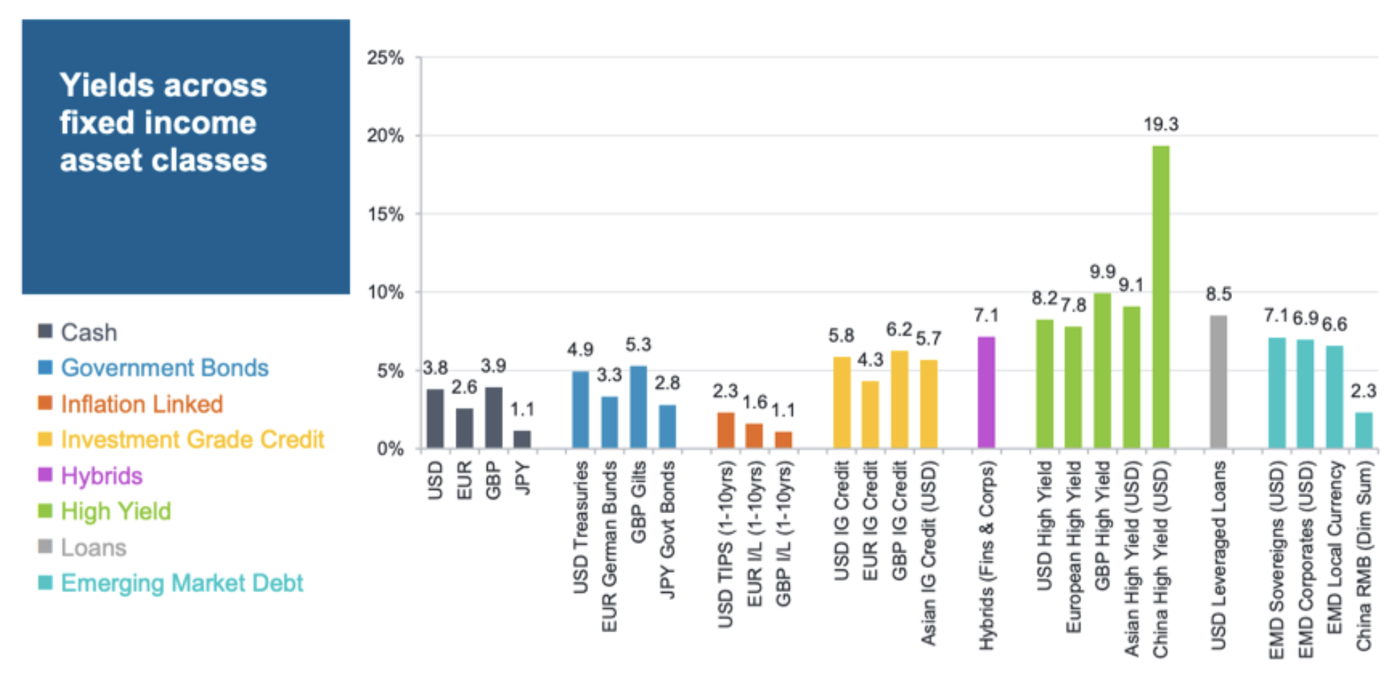
Source: Fidelity International, Bloomberg, JPM and ICE BofA Merrill Lynch bond indices, 31 October 2026. Yield to maturity for all instruments except HY (yield to worst) and EM (duration weighted yield to worst), USD loans (yield to 3yrs), and inflation-linked bonds (real yield). Hybrids universe defined as 50% Corporate Hybrids and 50% Financial Hybrids indices.
Summary of returns – 31 October 2026 (%)
| 1 Month | YTD | 2025 | 2024 | 2023 | 2022 | 2021 | |
|---|---|---|---|---|---|---|---|
| Government | |||||||
| US Treasuries | 2.4 | -0.4 | 6.2 | 0.5 | 3.9 | -12.9 | -2.4 |
| EUR Bunds | 1.9 | -0.4 | -1.5 | 0.5 | 5.1 | -17.6 | -2.6 |
| UK Gilts | 1.6 | -1.2 | 5.0 | -4.1 | 3.7 | -25.1 | -5.3 |
| Inflation Linked | |||||||
| USD | 2.7 | 0.5 | 6.8 | 2.0 | 3.6 | -12.6 | 6.0 |
| EUR | 0.6 | 0.1 | 1.1 | 0.3 | 5.0 | -8.1 | 6.2 |
| GBP | 2.3 | 1.2 | 1.3 | -8.8 | 0.7 | -34.4 | 3.9 |
| Investment Grade Corporate | |||||||
| USD | 2.0 | -0.8 | 7.8 | 2.8 | 8.4 | -15.4 | -1.0 |
| EUR | 0.8 | -0.5 | 3.0 | 4.7 | 8.0 | -13.9 | -1.0 |
| GBP | 0.6 | -0.5 | 7.1 | 1.9 | 9.7 | -19.5 | -3.0 |
| Asian Dollar | 1.4 | -0.8 | 7.9 | 3.6 | 7.5 | -11.0 | 0.0 |
| Financial and Corporate Hybrids | |||||||
| Contingent Convertibles | 0.1 | 1.3 | 10.0 | 12.2 | 5.7 | -11.4 | 4.7 |
| Investment Grade Corporate Hybrids | 0.7 | -0.4 | 6.7 | 8.4 | 10.2 | -12.9 | 1.4 |
| High Yield | |||||||
| US | 0.3 | 0.3 | 8.5 | 8.2 | 13.5 | -11.2 | 5.4 |
| European | -1.1 | -1.0 | 6.4 | 8.3 | 13.1 | -13.9 | 3.3 |
| Asia | -3.5 | 6.0 | 8.1 | 16.5 | -0.1 | -13.3 | -6.2 |
| Emerging Markets | |||||||
| EM USD Sovereigns | 1.1 | 0.7 | 14.3 | 6.5 | 11.1 | -17.8 | -1.8 |
| EM USD Corporates | 0.4 | 0.9 | 8.7 | 7.6 | 9.1 | -12.3 | 0.9 |
| EM Local Currency (USD unhedged) | -0.3 | -0.2 | 19.3 | -2.4 | 12.7 | -11.7 | -8.7 |
| China RMB | -0.8 | 2.9 | 10.8 | 3.8 | 4.8 | 1.9 | 3.2 |
Source: Fidelity International, ICE, Bloomberg, 31 October 2026. JPM and ICE BofA bond indices for total returns. ICE BofA Merrill Lynch Q490 Index for Asia high yield.
The full Fixed Income Monthly on Fidelity's website also includes:
This article was originally published by Fidelity International. For the full Fixed Income Monthly, including detailed sector views and the quant tactical scorecard, visit their website.
Important information
Reference to specific securities should not be construed as a recommendation to buy or sell these securities and is included for the purposes of illustration only.
Investors should note that the views expressed may no longer be current and may have already been acted upon.
The value of investments and the income from them can go down as well as up so you may get back less than you invest. Past performance is not a reliable indicator of future results.
Bond investments: The price of bonds is influenced by movements in interest rates, changes in the credit rating of bond issuers, and other factors such as inflation and market dynamics. In general, as interest rates rise the price of a bond will fall. The risk of default is based on the issuer's ability to make interest payments and to repay the loan at maturity. Default risk may, therefore, vary between different government issuers as well as between different corporate issuers.
Corporate bonds: Due to the greater possibility of default an investment in a corporate bond is generally less secure than an investment in government bonds.
High yield bonds: Sub-investment grade bonds are considered riskier bonds. They have an increased risk of default which could affect both income and the capital value of the Fund investing in them.
Overseas Markets: Overseas investments will be affected by movements in currency exchange rates. The value of the investment can be affected by changes in currency exchange rates.
Currency Hedging: Currency hedging is used to substantially reduce the risk of losses from unfavourable exchange rate movements on holdings in currencies that differ from the dealing currency. Hedging also has the effect of limiting the potential for currency gains to be made.
Emerging Markets: Investing in emerging markets can be more volatile than other more developed markets.
Derivatives: Some fixed income investments may make use of derivatives and this may result in leverage. In such situations performance may rise or fall more than it would have done otherwise, and expose investors to the risk of financial loss if a counterparty used for derivative instruments subsequently defaults.
Hybrid securities: Hybrid securities typically combine both equity and debt sensitivities and exposures. Hybrid bonds are subordinated instruments that have equity like characteristics. Typically, they include long final maturity (or no limitation on maturity) and have a call schedule increasing reinvestment risk. Their subordination typically lies somewhere between equity and other subordinated debt. As such, as well as typical ‘bond’ risk factors, hybrid securities also convey such risks as the deferral of interest payments, equity market volatility and illiquidity. Contingent convertible securities (“CoCos”) are a form of hybrid debt security that are intended to either convert into equity or have their principal written down upon the occurrence of certain ‘triggers’ linked to regulatory capital thresholds or where the issuing banking institution’s regulatory authorities considers this to be necessary. CoCos will have unique equity conversion or principal write-down features which are tailored to the issuing banking institution and its regulatory requirements.
This material is for Institutional Investors and Investment Professionals only, and should not be distributed to the general public or be relied upon by private investors.
This material is provided for information purposes only and is intended only for the person or entity to which it is sent. It must not be reproduced or circulated to any other party without prior permission of Fidelity.
This material does not constitute a distribution, an offer or solicitation to engage the investment management services of Fidelity, or an offer to buy or sell or the solicitation of any offer to buy or sell any securities in any jurisdiction or country where such distribution or offer is not authorised or would be contrary to local laws or regulations. Fidelity makes no representations that the contents are appropriate for use in all locations or that the transactions or services discussed are available or appropriate for sale or use in all jurisdictions or countries or by all investors or counterparties.
This communication is not directed at, and must not be acted on by persons inside the United States. All persons and entities accessing the information do so on their own initiative and are responsible for compliance with applicable local laws and regulations and should consult their professional advisers. This material may contain materials from third-parties which are supplied by companies that are not affiliated with any Fidelity entity (Third-Party Content). Fidelity has not been involved in the preparation, adoption or editing of such third-party materials and does not explicitly or implicitly endorse or approve such content. Fidelity International is not responsible for any errors or omissions relating to specific information provided by third parties.
Fidelity International refers to the group of companies which form the global investment management organization that provides products and services in designated jurisdictions outside of North America. Fidelity, Fidelity International, the Fidelity International logo and F symbol are trademarks of FIL Limited. Fidelity only offers information on products and services and does not provide investment advice based on individual circumstances, other than when specifically stipulated by an appropriately authorised firm, in a formal communication with the client.
Europe: Issued by FIL Pensions Management (authorised and regulated by the Financial Conduct Authority in UK), FIL Investment Management (Luxembourg) S.à r.l. (authorised and supervised by the CSSF, Commission de Surveillance du Secteur Financier), FIL Gestion (authorised and supervised by the AMF (Autorité des Marchés Financiers) N°GP03-004, 21 Avenue Kléber, 75016 Paris) and FIL Investment Switzerland AG.
UAE: The DIFC branch of FIL Distributors International Limited is regulated by the DFSA for the provision of Arranging Deals in Investments only. All communications and services are directed at Professional Clients and Market Counterparties only. Persons other than Professional Clients and Market Counterparties, such as Retail Clients, are NOT the intended recipients of our communications or services. The branch is established pursuant to the DIFC Companies Law, with registration number CL2923, as a branch of FIL Distributors International Limited, registered in Bermuda. FIL Distributors International Limited is licensed to conduct investment business by the Bermuda Monetary Authority.
In Hong Kong, this material is issued by FIL Investment Management (Hong Kong) Limited and it has not been reviewed by the Securities and Future Commission.
FIL Investment Management (Singapore) Limited (Co. Reg. No: 199006300E) is the legal representative of Fidelity International in Singapore. This document / advertisement has not been reviewed by the Monetary Authority of Singapore.
In Taiwan, Independently operated by Fidelity Securities Investment Trust Co. (Taiwan) Limited 11F, No.68, Zhongxiao East Road, Section 5, Taipei 110, Taiwan, R.O.C. Customer Service Number: 0800-00-9911.
In Korea, this material is issued by FIL Asset Management (Korea) Limited. This material has not been reviewed by the Financial Supervisory Service, and is intended for the general information of institutional and professional investors only to which it is sent.
Issued in Japan, this material is prepared by FIL Investments (Japan) Limited (hereafter called “FIJ”) based on reliable data, but FIJ is not held liable for its accuracy or completeness. Information in this material is good for the date and time of preparation, and is subject to change without prior notice depending on the market environments and other conditions. All rights concerning this material except quotations are held by FIJ, and should by no means be used or copied partially or wholly for any purpose without permission. This material aims at providing information for your reference only but does not aim to recommend or solicit funds /securities.
For information purposes only. Neither FIL Limited nor any member within the Fidelity Group is licensed to carry out fund management activities in Brunei, Indonesia, Malaysia, Thailand and Philippines.
FIL Investment Management (Australia) Limited (ABN 34 006 773 575, AFSL No. 237865) and FIL Responsible Entity (Australia) Limited (ABN 33 148 059 009, AFSL No. 409340) are the legal representatives of Fidelity International in Australia. This is intended as general information for a person who is a "wholesale client" under section 761G of the Corporations Act 2001 (Cth) and has been prepared without taking into account any person’s objectives, financial situation or needs. Not for distribution to or use by retail clients.
In China, Fidelity China refers to FIL Fund Management (China) Company Limited. Investment involves risks. Business separation mechanism is conducted between Fidelity China and the shareholders. The shareholders do not directly participate in investment and operation of fund property. Past performance is not a reliable indicator of future results, nor the guarantee for the performance of the portfolio managed by Fidelity China.
FIPM 11001