


06 Oct 2026
Why the case for owning IG as an income asset has rarely been stronger.
For years, income-seeking investors had to venture down the credit spectrum into high yield (HY), accepting materially higher default risk in exchange for a bigger coupon. It was, for a long time, simply the cost of generating income from bonds. That trade-off has now narrowed dramatically. Today, investment grade (IG) credit offers a rare and powerful combination; a genuine, competitive income yield, delivered in an asset class that has historically almost never defaulted (see chart 3). For income-focused investors, this changes the equation entirely.
With the IG index yielding over 5%, credit has been repriced from a low-yielding portfolio diversifier into a serious, standalone source of income. This is a meaningful shift. For much of the past decade, IG yields sat well below the level at which they could anchor an income strategy on their own. Now, for the first time in years, an investor can build a substantial and reliable income stream without having to leave the relative safety of the investment grade universe. No reaching for yield, no stepping down in quality.
This second point is where the investment case becomes compelling, as the below chart demonstrates. Over the long run, the total return of the IG index can be explained almost entirely by its income component. The income line marches steadily and predictably upward, while the price-return line oscillates around zero and contributes very little over time. The price rises and falls with the cycle, and the coupon simply keeps compounding.
Chart 1 — Income, not price, is the driver of IG total returns

Source: Bloomberg
For an income-oriented investor, this is precisely the return profile you want. Your returns arrive as a coupon you clip along the way, not as capital appreciation you have to hope the market eventually delivers. It makes IG a dependable engine of income rather than a bet on price direction — durable, repeatable, and far less dependent on timing the market.
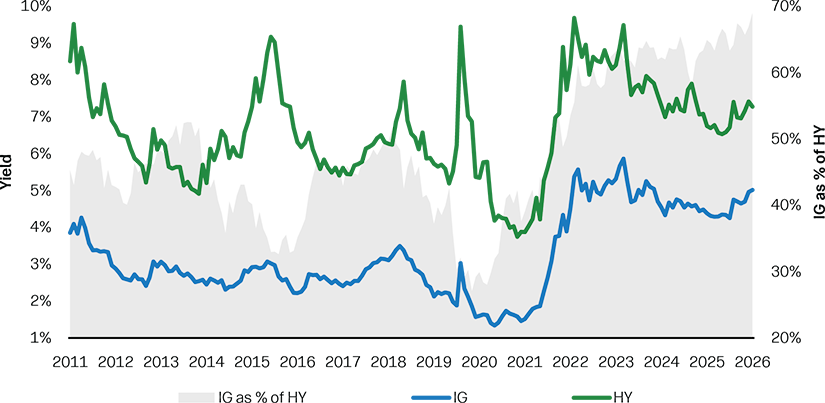
Historically, the price of moving into IG was sacrificing a large slice of income relative to HY. That premium has rarely been thinner. As the chart below shows, the IG yield has never been higher as a proportion of the HY yield over the past 20 years. The traditional income advantage of taking on HY risk — the very reason income investors held their noses and bought it — has compressed to historically unusual levels.
Chart 2 — IG yield as a proportion of HY yield: at a 20-year high
Source: Bloomberg
In other words, you can now capture the bulk of high yield’s income while staying firmly in IG. The compensation for investing into riskier credit has seldom looked so modest relative to the yields on offer in higher-quality bonds.
What makes this so attractive is that the income has converged while the risk emphatically has not. The default experience of the two asset classes could hardly be more different. Over the last decade, IG defaults have been effectively zero — never more than a small handful in any single year — while HY defaults have run into the dozens or even hundreds annually, spiking toward 200 in the stress of 2020.
Chart 3 — Number of defaults per year: IG versus HY

Source: S&P Global Ratings — 2024 Annual Global Corporate Default & Rating Transition Study (27 March 2025)
So you are being asked to give up very little income to move up in quality, yet the protection you gain in return is significant.
I believe the opportunity to capture most of high yield’s coupon in an asset class that has defaulted a tiny fraction as often is a far better balance of income earned against risk borne.
Put simply: I believe there has never been a better time in the past two decades to own investment grade credit as an income play. IG now yields over 5%, its returns are driven by dependable income rather than uncertain price movements, and its yield has never stood so high relative to HY. Yet it retains the defining advantage of the asset class, a default record that high yield cannot come close to matching. For the income-seeking investor, that is a rare alignment of yield, quality, and value all at once.