


06 Nov 2026
Most coverage of AI debt issuance has focused on the US investment-grade bond market. This is understandable given the sheer scale of the issuance in this market and the significant amount of risk within US investment-grade benchmarks now centred on AI-related issuance.
What has gone under the radar has been the rapidly scaling issuance happening in the high-yield bond market.
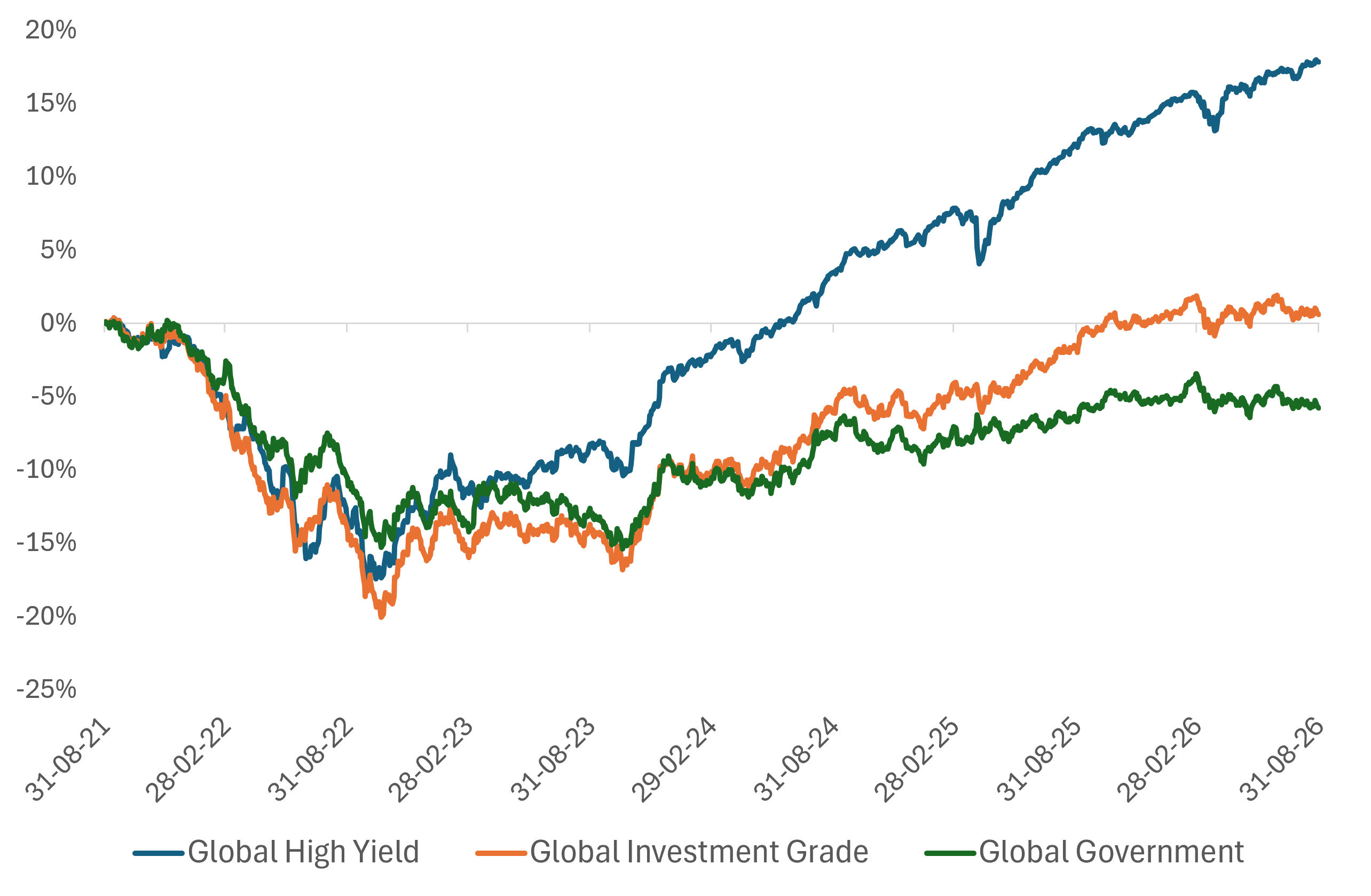
High yield has been something of a safe haven from concerns about fiscal spending, deficits and government bond yields over recent years. Its combination of higher income levels and lower levels of duration (meaning it is less sensitive to moves in interest rates and government bond markets) has led it to outperform global investment-grade corporate and government bonds over the past five years by a wide margin1.
Source: ICE BofA Indices, as at 7 September 2026
High yields and low exposure to the issues facing indebted governments remain attractive, which is why high-yield bonds account for the majority of the Artemis High Income Fund’s portfolio2.
However, AI has turned many markets on their head this year and high yield is no exception. The Bank of England estimates that AI companies have accounted for 41% of new issuance in the US high-yield market in 2026 so far3 (not including the refinancing of old debt). AI-related debt has gone from being under 1% of the global high-yield market at the beginning of the year4 to more than 3% today. With the rapid growth of data centres in need of financing, this pace of growth looks unlikely to slow down.
This raises the question of whether AI issuance in the high-yield market is an opportunity or a threat.
To assess the opportunities, I think it is important to separate two concepts. The first is whether AI is a monumental technological change that will have a significant impact on the global economy. The second is whether the bonds being issued offer an attractive risk/reward trade-off.
On the former, we as a team use AI extensively to assist us in our credit work, helping to evaluate legal documents, conduct initial research on niche industries and stay on top of news developments. We are, to put it simplistically, ‘believers’ in the significant productivity benefits AI can provide.
However, when we look at the risk/reward for AI issuance within the high-yield market, we think it fails to cut the mustard. The reality is that if AI is the transformative technology we think it might be, and the companies we lend to manage to capture a significant part of a profitability pool that doesn’t exist yet (and nobody really knows what it will look like when it does), we will still only get paid our coupon and principal. We will not share in any upside beyond this.
However, given the pace of technological change (and the uncertainty of possible outcomes), the chance of a negative outcome is much higher than for a less uncertain industry. In this scenario, bonds can still lose 100% of the money we have invested in them. It’s a case of heads we don’t really win, tails we lose.
This also highlights one of the excellent side-effects of not being tied to an index. If we are completely index-agnostic, the fact that AI debt is 1%, 3%, 10% or 20% of the market is not something we need to worry about. Instead, we can focus on whether we actually want to lend money to the companies we buy bonds in, rather than whether the crowd has leant money to them. History suggests that avoiding ‘the wisdom of the crowd’ in high-yield debt markets when there is a fast-growing sector – such as telecommunications in the late 1990s and oil & gas in the mid 2010s – is a profitable strategy over the long term.
So, I’ve hopefully illustrated why I don’t think the AI bonds being issued in the high-yield market represent an opportunity for investors. However, should we go further than this and suggest they represent a threat? Perhaps there will be contagion in the market if the AI sector grows and underperforms?
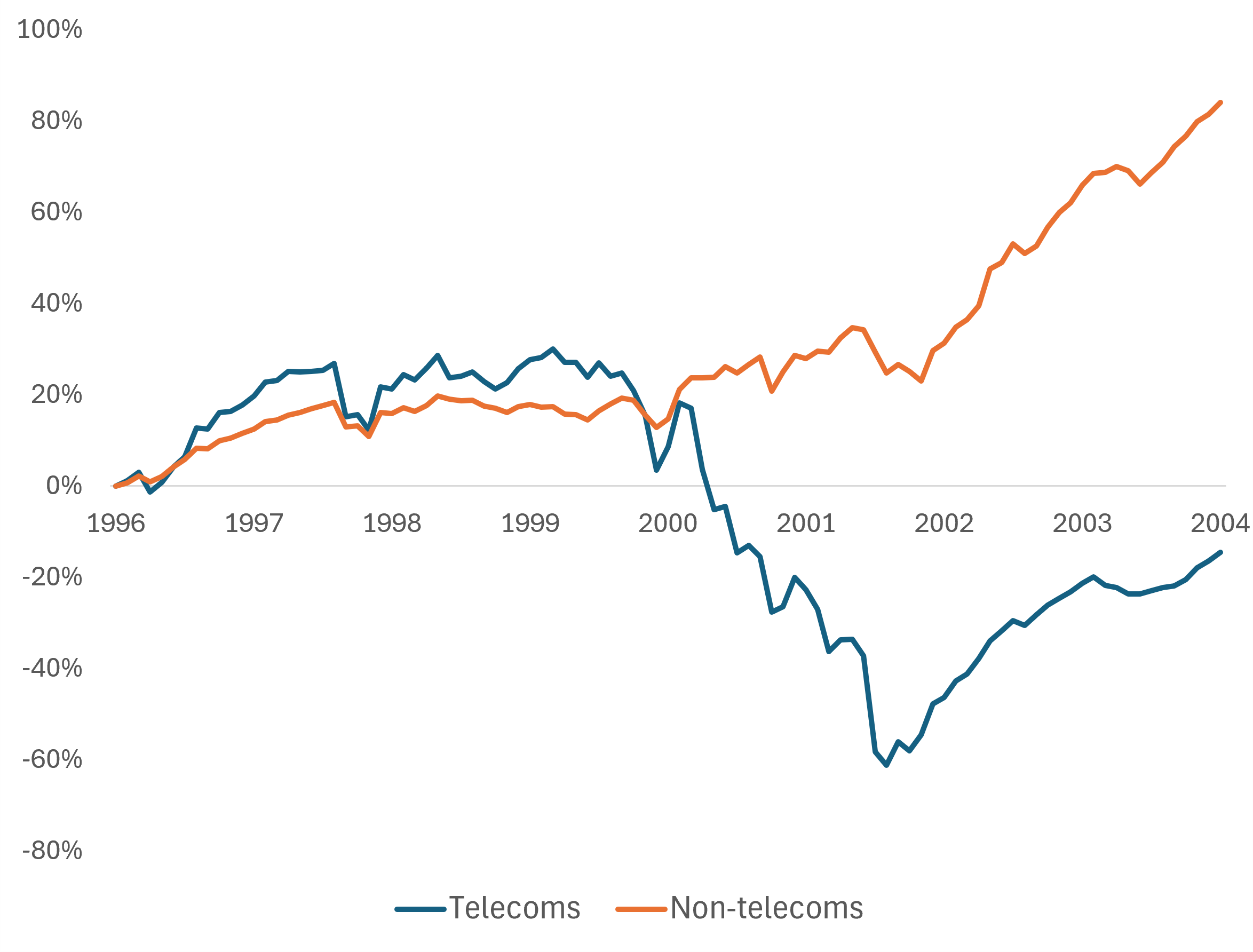
The evidence from the expansion of telco high-yield debt in the late 1990s provides an answer. At the end of 1996, telecommunications made up 6.9% of the total US high-yield market. Just three years later, the sector made up over 20%. Companies in the sector issued billions of dollars of debt to fund cable networks, built to carry the vast expansion in data expected from the spread of the internet. While they weren’t wrong that this demand would develop, they were unfortunately off with both their timing and their understanding of how profitability within the industry would be captured. As a result, the high-yield telecommunications sector of the market lost 70% in the early 2000s.
However, the interesting element here is that over the same period, the other 80-or-so-percent of the high-yield market delivered a positive total return. In other words, there was no contagion impact.
Source: ICE BofA Indices, as at 7 September 2026
It’s for this reason that within the High Income Fund, we continue to focus on shorter-dated, higher-quality, high-yield bonds away from the AI sector. Here, we see attractive mid-to-high single-digit income-driven returns with very little exposure to either the wave of AI issuance or other concerns around longer-dated bonds.
This article first appeared in IFA Magazine
1 & 2 Source: Artemis to 30 September 2026
3 & 4 Source: Bank of England Financial Stability Report, July 2026
FOR PROFESSIONAL INVESTORS AND/OR QUALIFIED INVESTORS AND/OR FINANCIAL INTERMEDIARIES ONLY. NOT FOR USE WITH OR BY PRIVATE INVESTORS.
CAPITAL AT RISK. All financial investments involve taking risk and the value of your investment may go down as well as up. This means your investment is not guaranteed and you may not get back as much as you put in. Any income from the investment is also likely to vary and cannot be guaranteed.
This is a marketing communication. Before making any final investment decisions, and to understand the investment risks involved, refer to the fund prospectus (or in the case of investment trusts, Investor Disclosure Document and Articles of Association), available in English, and KIID/KID, available in English and in your local language depending on local country registration, available in the literature library.