

16 Nov 2026
After a volatile October for technology stocks, our research team explores the potential implications for hyperscalers, semiconductors and AI infrastructure. They also highlight the key takeaways for investors and emphasise the need for selectivity as the AI theme continues to evolve.
By Matthew Jennings, Fidelity International
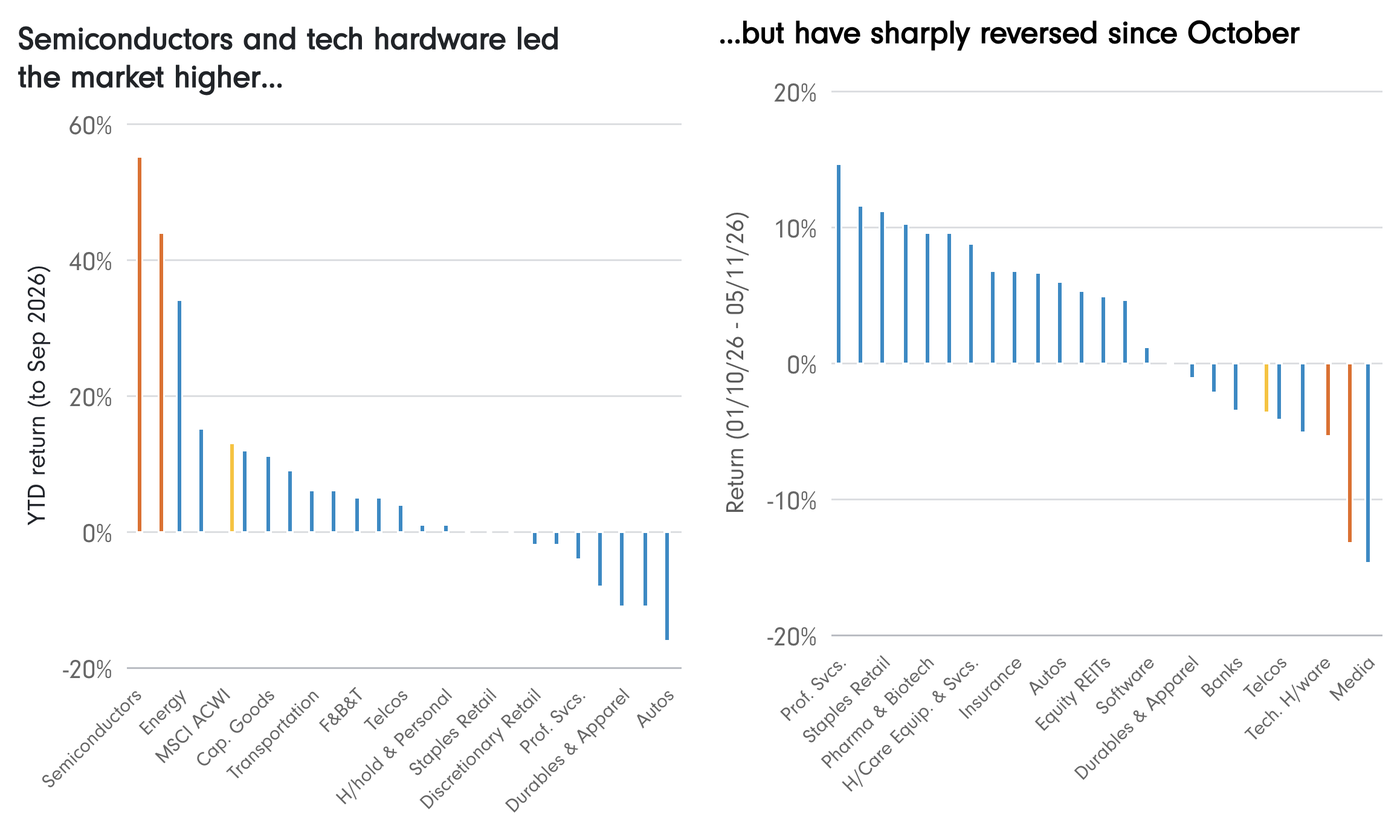
October saw a sharp reversal in technology stocks, particularly companies exposed to artificial intelligence (AI). The PHLX Semiconductor Index fell approximately 15%, while the technology-heavy Nasdaq Composite declined 5%. Individual companies experienced larger moves, with Alphabet falling 19% and AI infrastructure provider CoreWeave losing 37%.
The sell-off follows a period of exceptional performance for AI-related stocks and reflects growing investor concerns about the scale, financing and profitability of AI investment. These concerns may have been amplified by crowded positioning and momentum-sensitive trading strategies, contributing to unusually large share price moves.
Importantly, the weakness has been concentrated in AI-exposed companies, with other sectors proving more resilient. Previously unloved defensive sectors such as consumer staples and healthcare benefited in what is better characterised as a rotation than a broad-based equity sell-off.
Semiconductors and tech hardware led the market higher… but have sharply reversed since October
Source: BofA Global Investment Strategy, Bloomberg. October 2026.
Our research suggests an important distinction: while investors are increasingly questioning the economics of AI investment, the underlying demand for AI technology and infrastructure remains strong. October's volatility reflects a reassessment of risk and reward rather than clear evidence that the AI investment cycle is ending. While we remain alert to further volatility, such periods can create attractive opportunities for fundamental investors able to distinguish between temporary market concerns and a genuine deterioration in long-term prospects.
Our analysts leverage their access to company management across the value chain, industry experts and a range of third-party data sources and analytical techniques in order make these distinctions. Discussions between our credit and equity analysts can be particularly helpful when financing costs are exerting a greater influence on equity prices.
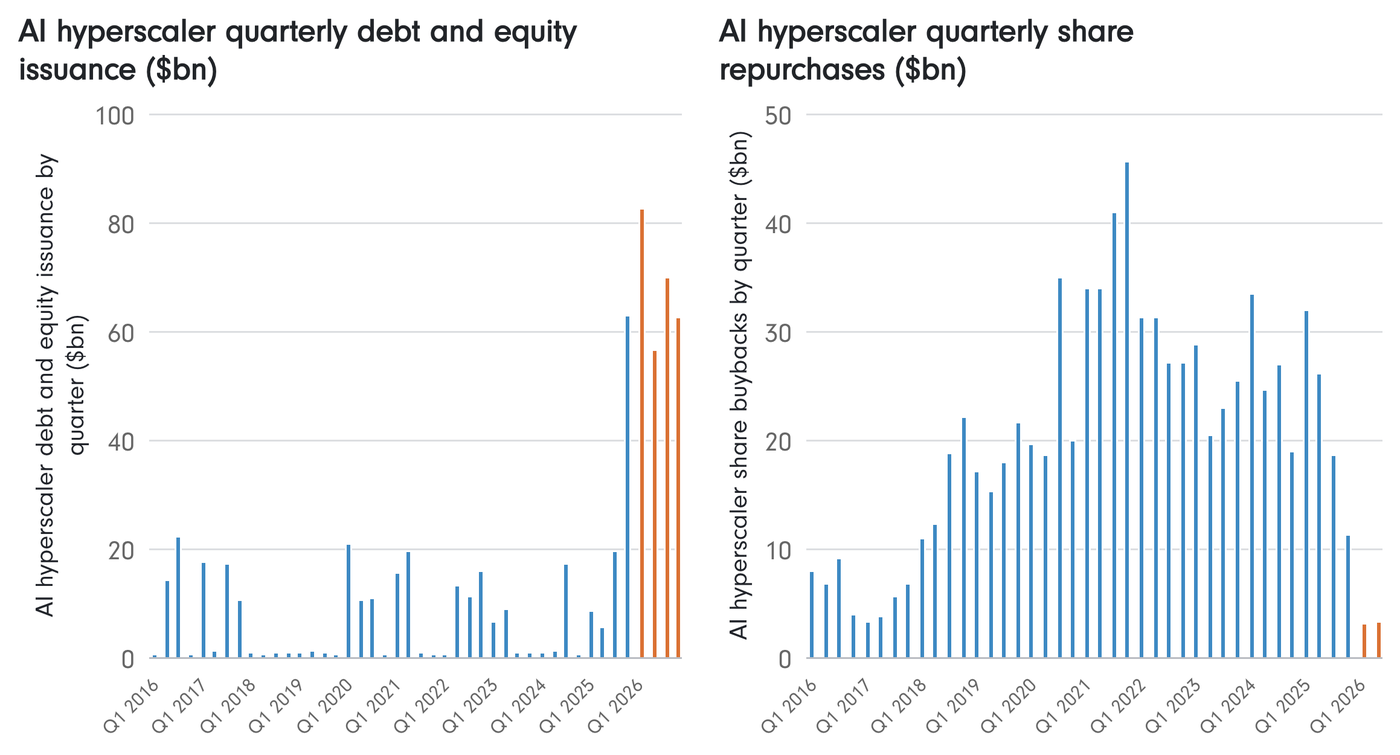
The world's largest cloud technology companies, including Alphabet, Microsoft, Amazon and Meta, are investing unprecedented amounts in AI infrastructure. This spending is supporting substantial demand for semiconductors, servers, data centres and the equipment needed to power and cool them. This increase in capital intensity, increasingly funded by debt issuance, has significantly reduced free cashflow across the sector, reducing scope for buybacks, thus removing a key source of return in previous years.
AI hyperscaler quarterly debt and equity issuance ($bn) and share repurchases ($bn)
Source: BofA Global Investment Strategy, Bloomberg. *AI hyperscalers = GOOG, META, AMZN, MSFT, ORCL. October 2026.
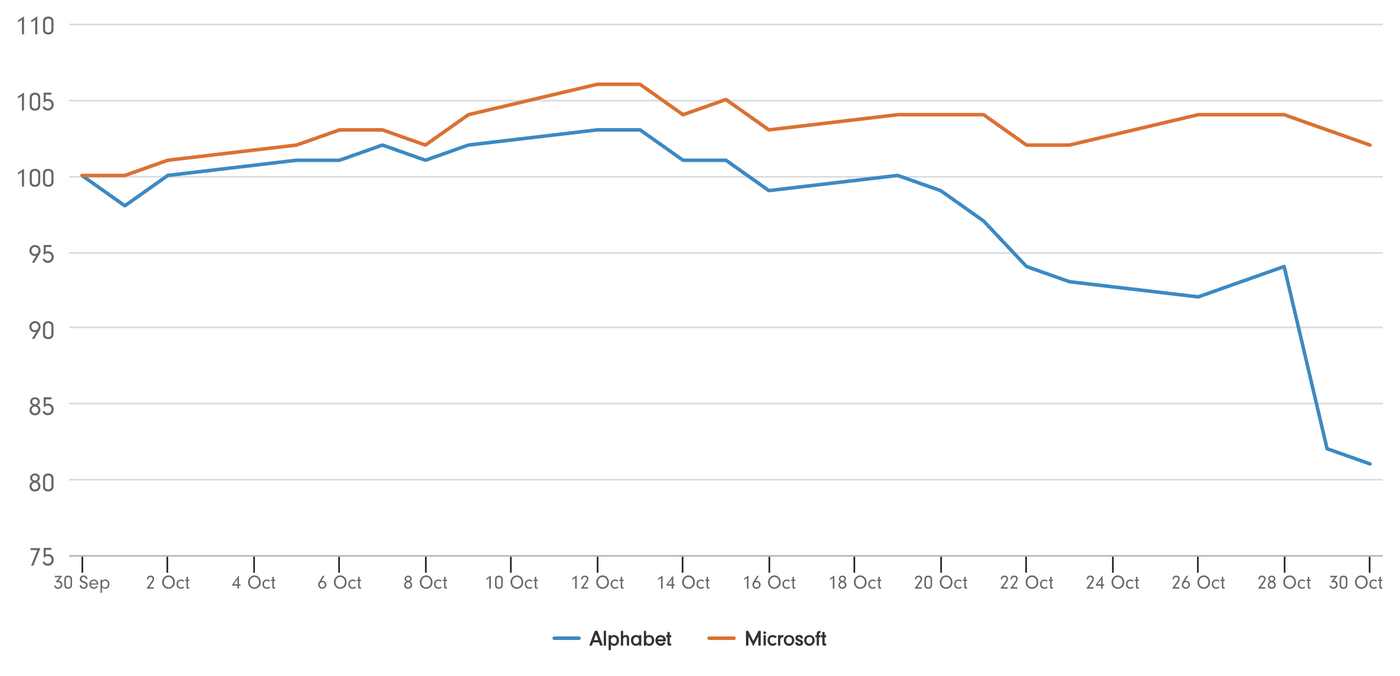
As such, investors are becoming increasingly focused on when this expenditure will translate into sustainable revenues, profits and cash flow. Financing is also attracting greater scrutiny, with rising investment commitments raising questions about future borrowing requirements and higher financing costs. Alphabet provides a striking example. Its shares fell approximately 13% on 29 October following its third quarter results, despite continued strong growth in its Cloud business. Investors focused instead on rising capital expenditure and concerns that AI-powered Search could generate lower advertising revenues than traditional Search.
Given the importance of Search to the overall investment thesis for Alphabet, our research team are investigating how long this monetisation gap could exist. We have meetings arranged with experts on digital advertising, former employees and company management, and will continue to monitor trends in the industry.
Alphabet trades at 13.5x Fidelity’s earnings estimates for next year, which is towards the lower end of its historic valuation range, so its long-term risk-reward seems favourable. However, greater confidence on the outlook for the Search business will be needed to drive a re-rating and recovery in the shares.
Microsoft's results provided a more positive counterpoint; Azure cloud revenue accelerated to 48% growth, earnings exceeded expectations, and importantly, there was less reliance on debt financing to fund what the market considered to be more reasonable future spending commitments. This provided some reassurance around the sustainability of Microsoft’s AI strategy.
Hyperscaler divergence in October: Alphabet vs Microsoft share price
Source: Bloomberg, November 2026.
Semiconductor stocks have been particularly volatile: Nvidia and Taiwan Semiconductor Manufacturing Company (TSMC) declined approximately 10% and 11%, Korean stocks Samsung and SK Hynix fell 16% and 19%, and Intel dropped 45% in the month, making it the worst performing stock in the S&P 500.
Despite these moves, our semiconductor analysts continue to report strong underlying demand. Advanced chip manufacturing capacity remains constrained, with demand for AI processors, memory and other critical components exceeding available supply in several areas.
TSMC’s latest results indicated strong demand for advanced chips, with the company investing in additional manufacturing capacity to address supply constraints. Importantly, TSMC is independently assessing data centre construction and power availability to validate demand before committing further capital.
Intel significantly reduced its earnings guidance for the PC segment, However, its data centre business, which is most exposed to the AI investment cycle, continued to perform well. The scale of Intel’s drawdown demonstrates the nervousness of investors and readiness to punish any company perceived to be faltering.
Following substantial share price appreciation, sentiment towards the semi sector remains highly sensitive to changes in growth expectations. Given our interactions with semiconductor companies and their downstream customers, we remain constructive on the underlying cycle. However, the importance of valuation discipline and diversification cannot be overstated in a sector likely to remain highly sensitive to changes in expectations.
The AI investment boom extends beyond technology companies and semiconductor manufacturers, creating substantial demand for data centres, power generation, cooling systems and networking equipment. The opportunities span multiple sectors, including established industrials, energy and construction companies, as well as new business models such as ‘neo-clouds’, whose heavy reliance on debt financing is increasingly attracting scrutiny as refinancing costs rise. For example, CoreWeave is a specialist provider of AI computing infrastructure. Its shares fell approximately 37% during October as investors questioned the financial sustainability of its rapid expansion.
Our credit analysts are monitoring increasingly complex financing arrangements, including structures backed by computing equipment and long-term data centre commitments. This collateral can support investment but introduces additional refinancing risks if future revenues disappoint.
Our analysts remain constructive on essential AI infrastructure providers, particularly networking, memory, power and cooling, where demand is supported by genuine physical bottlenecks. However, they are more cautious towards highly leveraged companies with less predictable cash flows.
We highlight three key takeaways.
October's volatility reinforces the importance of fundamental research, valuation discipline and diversification. Periods of heightened uncertainty can create attractive entry points, but identifying them requires a clear understanding of company fundamentals and a disciplined approach to portfolio construction. As the AI investment cycle evolves, rigorous research and active stock selection will be key to distinguishing companies capable of delivering sustainable returns.
This article was originally published by Fidelity International. For more insights and articles from Fidelity, visit their website.
Important information
Marketing communication.
This material is for Institutional Investors and Investment Professionals only, and should not be distributed to the general public or be relied upon by private investors.
This material is provided for information purposes only and is intended only for the person or entity to which it is sent. It must not be reproduced or circulated to any other party without prior permission of Fidelity.
This material does not constitute a distribution, an offer or solicitation to engage the investment management services of Fidelity, or an offer to buy or sell or the solicitation of any offer to buy or sell any securities in any jurisdiction or country where such distribution or offer is not authorised or would be contrary to local laws or regulations. Fidelity makes no representations that the contents are appropriate for use in all locations or that the transactions or services discussed are available or appropriate for sale or use in all jurisdictions or countries or by all investors or counterparties.
This communication is not directed at, and must not be acted on by persons inside the United States. All persons and entities accessing the information do so on their own initiative and are responsible for compliance with applicable local laws and regulations and should consult their professional advisers. This material may contain materials from third-parties which are supplied by companies that are not affiliated with any Fidelity entity (Third-Party Content). Fidelity has not been involved in the preparation, adoption or editing of such third-party materials and does not explicitly or implicitly endorse or approve such content. Fidelity International is not responsible for any errors or omissions relating to specific information provided by third parties.
Fidelity International refers to the group of companies which form the global investment management organization that provides products and services in designated jurisdictions outside of North America. Fidelity, Fidelity International, the Fidelity International logo and F symbol are trademarks of FIL Limited. Fidelity only offers information on products and services and does not provide investment advice based on individual circumstances, other than when specifically stipulated by an appropriately authorised firm, in a formal communication with the client.
Europe: Issued by FIL Pensions Management (authorised and regulated by the Financial Conduct Authority in UK), FIL (Luxembourg) S.A. (authorised and supervised by the CSSF, Commission de Surveillance du Secteur Financier), FIL Gestion (authorised and supervised by the AMF (Autorité des Marchés Financiers) N°GP03-004, 21 Avenue Kléber, 75016 Paris) and FIL Investment Switzerland AG.
In Hong Kong, this material is issued by FIL Investment Management (Hong Kong) Limited and it has not been reviewed by the Securities and Future Commission.
FIL Investment Management (Singapore) Limited (Co. Reg. No: 199006300E) is the legal representative of Fidelity International in Singapore. This document / advertisement has not been reviewed by the Monetary Authority of Singapore.
In Taiwan, Independently operated by Fidelity Securities Investment Trust Co. (Taiwan) Limited 11F, No.68, Zhongxiao East Road, Section 5, Taipei 110, Taiwan, R.O.C. Customer Service Number: 0800-00-9911.
In Korea, this material is issued by FIL Asset Management (Korea) Limited. This material has not been reviewed by the Financial Supervisory Service, and is intended for the general information of institutional and professional investors only to which it is sent.
In China, Fidelity China refers to FIL Fund Management (China) Company Limited. Investment involves risks. Business separation mechanism is conducted between Fidelity China and the shareholders. The shareholders do not directly participate in investment and operation of fund property. Past performance is not a reliable indicator of future results, nor the guarantee for the performance of the portfolio managed by Fidelity China.
Issued in Japan, this material is prepared by FIL Investments (Japan) Limited (hereafter called “FIJ”) based on reliable data, but FIJ is not held liable for its accuracy or completeness. Information in this material is good for the date and time of preparation, and is subject to change without prior notice depending on the market environments and other conditions. All rights concerning this material except quotations are held by FIJ, and should by no means be used or copied partially or wholly for any purpose without permission. This material aims at providing information for your reference only but does not aim to recommend or solicit funds /securities.
UAE: The DIFC branch of FIL Distributors International Limited is regulated by the DFSA for the provision of Arranging Deals in Investments only. All communications and services are directed at Professional Clients and Market Counterparties only. Persons other than Professional Clients and Market Counterparties, such as Retail Clients, are NOT the intended recipients of our communications or services. The branch is established pursuant to the DIFC Companies Law, with registration number CL2923, as a branch of FIL Distributors International Limited, registered in Bermuda. FIL Distributors International Limited is licensed to conduct investment business by the Bermuda Monetary Authority.
For information purposes only. Neither FIL Limited nor any member within the Fidelity Group is licensed to carry out fund management activities in Brunei, Indonesia, Malaysia, Thailand and Philippines.
FIL Investment Management (Australia) Limited (ABN 34 006 773 575, AFSL No. 237865) and FIL Responsible Entity (Australia) Limited (ABN 33 148 059 009, AFSL No. 409340) are the legal representatives of Fidelity International in Australia. This is intended as general information for a person who is a "wholesale client" under section 761G of the Corporations Act 2001 (Cth) and has been prepared without taking into account any person’s objectives, financial situation or needs. Not for distribution to or use by retail clients.
GLEMUS6073-0227