

22 Jul 2026
Emerging Market (EM) equities are back in the spotlight, delivering robust year to date returns driven largely by the IT sector and rising index concentration. While many of the largest constituents remain attractive, compelling opportunities can also be found across sectors, market capitalisations and geographies.
Emerging Market (EM) equities are firmly back in the spotlight. Despite a pullback in the market after the outbreak of the Middle East conflict in March, the asset class has returned ~22% year-to-date overall (in US dollar terms), significantly outperforming developed markets (DM).
With much of this strength coming from the IT sector, several EM tech mega caps are garnering increasing attention, with index concentration on the rise – the three largest stocks in MSCI EM (semiconductor foundry TSMC, and memory producers Samsung Electronics and SK Hynix) now represent ~30% of the index.
The performance of these mega cap stocks is broadly warranted. Hyperscaler AI capex has been driving rising demand, whilst capacity remains tight across much of the AI supply chain, including in advanced node production and memory.
However, these megacaps, while compelling, are not the only opportunities in EM. Wide dispersion in the market, both in terms of returns and valuations, combined with several powerful structural and cyclical trends, means there is significant opportunity for active stock pickers beyond the largest index constituents, including further down the cap spectrum, in frontier markets, and among some of the lesser-known beneficiaries of AI capex. With this in mind, here are some of the more under-the-radar stocks that we think are worth knowing about.
The backdrop for the Chinese market remains complex. Weakness within the housing market looks likely to persist, and with property as a significant source of wealth, this continues to weigh on consumer confidence. The banking sector also appears challenged, given declining asset quality and pressure on margins from a rate-cutting environment. However, there are pockets of opportunity within the market, including among higher tech industrials, where China is moving up the value chain. Here, there are several Chinese companies driving innovation and benefitting from strong growth within the export market.
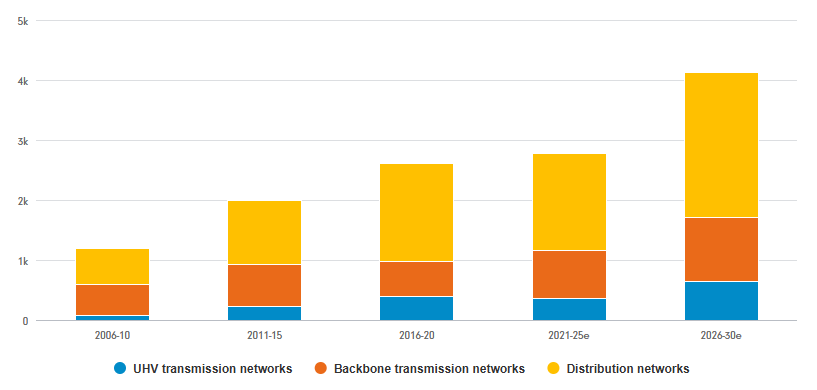
Sieyuan Electric is a manufacturer of high voltage switchgear and transformers used in power transmission, which is not currently included in the EM index due to foreign ownership limits. Recent blackouts across Spain and Portugal have highlighted that the global grid is antiquated and requires significant repair, whilst the build-out of renewables and growing electricity demands, driven in part by AI datacentres, also require a more robust grid. As a result, it looks likely that we are in a multi-year global grid capex upcycle. China is a clear example of this, with its Five-year Plan forecasting a significant uptick in grid spend.
China’s Five-year Plan forecasts a significant uptick in grid investment
Source: CEO, State Grid, Morgan Stanley Research estimates, as of 7 April 2026.
Sieyuan Electric is well-placed to capitalise on this growing domestic grid investment. Whilst the competitive landscape in China is dominated by state owned enterprises (SOEs), Sieyuan’s private ownership model allows it to attract the best engineers in the country, supporting expansion into new product lines and market share capture. This is reinforced by the company’s high Research and Development (R&D) spend relative to global peers, which means it is driving much of the innovation within the Chinese grid components space.
Sieyuan is also benefitting from global grid spend more broadly. Global supply of high-voltage transformers is constrained, with key peers in the market, such as Germany’s Siemens, facing long order backlogs. As a result, buyers are turning to Sieyuan for quicker delivery, resulting in rapid growth in the company’s export market. Given Sieyuan currently has a low overseas market share (~0.8% of its addressable overseas market in 2025, according to our analyst estimates), this provides a long runway for further growth and market share gains.
The financials sector tends to trade at a considerable discount to DM, with several high returning banks trading on single digit multiples. Value can be found in smaller emerging markets, many of which benefit from a more consolidated market structure than typically seen in the developed world.
Mid-cap Georgian banking group TBC Bank exemplifies this. With a population of just under 5 million, Georgia, a frontier market, is too small to attract meaningful competition. As a result, TBC Bank is one of two dominant banks in Georgia, which have a combined market share of ~80%.
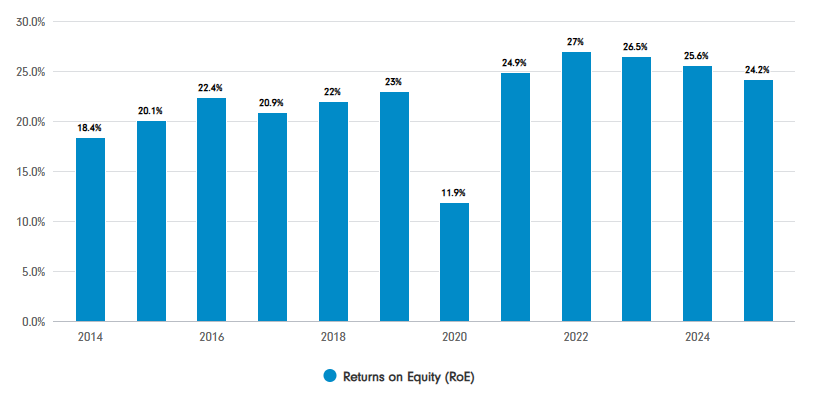
Beyond the favourable market structure, there are several fundamental factors which make TBC Bank an attractive investment. The bank is well capitalised and consistently generates robust returns on assets, while positive loan growth trends provide a clear pathway for continued earnings expansion. This combination supports strong returns on equity, with the bank’s ability to deploy excess capital into a fast-growing loans market supporting the sustainability of these returns. Despite this, TBC trades on a mid single digit earnings multiple; cheap for such a dominant, profitable bank.
TBC Bank has delivered consistently double digit Returns on Equity
Source: Fidelity International, company data, as of 31 December 2025.
TBC Bank also offers meaningful upside optionality through its expansion into Uzbekistan, where the group has recently launched a digital bank. Uzbekistan has a population ~7x larger than Georgia’s, with a more immature banking system, creating a substantially larger addressable market and scope for significant growth over the long term.
Whilst much of the global AI narrative has focussed on a select few mega caps, a significant proportion of the value accrual from AI will go to EM more broadly. As a result, we think there are also attractive opportunities further down the AI supply chain.
Taiwan’s Elite Material is a manufacturer of copper clad laminate (CCL) used in printed circuit boards, traditionally for use in electronics but increasingly for AI servers. Here, the supply-demand backdrop is favourable. Server projects are driving a significant rise in high-end CCL demand, while supply remains tight, with only a few companies able to produce this grade of CCL. Elite is one of them, and benefits from an almost 50% market share in this segment. With supply expected to remain tight despite significant capacity expansion plans, Elite should continue to benefit from strong pricing power.
Beyond this attractive supply-demand dynamic, there are additional drivers of profitability. The shift towards AI/high-end infrastructure as Elite’s core business should support margins, given this segment of the market is associated with higher prices. Similarly, as the complexity of printed circuit boards rapidly increases, this shift in product mix should underpin continued average selling price (ASP) increases and margin expansion.
Against a backdrop of rising concentration within the IT sector, opportunities further down the AI supply chain like Elite are an attractive way of accessing the AI theme while building a more diversified tech hardware allocation, particularly given the forced underweight in TSMC faced by UCITs funds (which are capped at 10% in individual stocks).
In 2026, the market’s gaze has been focused on the AI winners, with particular emphasis on those largest EM index constituents. While these businesses retain their attractions, they represent only a fraction of the opportunities available across a diverse investment universe. Compelling businesses can be found across sectors, market capitalisations and geographies - from China's grid infrastructure build-out and Georgia's highly profitable banking sector to the less visible beneficiaries of the AI supply chain in Taiwan.
In an asset class characterised by wide dispersion in both valuations and fundamentals, we believe a genuinely active approach is essential. By looking beyond the largest index constituents and focusing on companies with durable competitive advantages, strong structural growth drivers and attractive valuations, investors can access a broader set of opportunities and build more resilient, diversified portfolios over the long term.