

16 Oct 2026
US equities continue to benefit from resilient economic growth, robust corporate earnings and accelerated investment in artificial intelligence. Yet concerns around concentrated market leadership, elevated valuations and a more uncertain interest rate environment suggest that investors may need to look beyond familiar large-cap names for the next phase of market leadership and opportunity.
The US economy continues to demonstrate considerable resilience. Consumer spending, healthy corporate balance sheets and AI-related investment have supported economic activity, while recent earnings growth has extended beyond large-cap technology companies. This provides a broadly constructive foundation for US equities going forward.
However, in our view, the conditions to enable further gains are becoming more demanding. Inflation remains persistent and, with rates once again rising, the borrowing environment may stay restrictive for longer than previously expected. Higher energy prices and geopolitical uncertainty add to the pressure, potentially raising companies’ financing costs and the hurdle for equity valuations. Against this backdrop, markets are increasingly distinguishing between businesses that can translate investment into cash flow and those whose valuations rely more heavily on future expectations.
This is particularly relevant in the context of AI. Investment in semiconductors, data centres, networking, power infrastructure and software continues to support earnings across the broader technology ecosystem. The opportunity is also starting to extend into industrials, advanced manufacturing, financials and, more broadly, those companies who are able to leverage AI to improve current - not future - productivity and revenue streams. Yet the path is unlikely to be uniform. As the investment cycle develops, evidence of earnings delivery and successful monetisation should become more important than thematic exposure alone.
At the same time, market leadership remains highly concentrated. Mega-cap technology companies continue to represent a substantial share of the broad US market, leaving many investors exposed to a relatively narrow collection of companies and return drivers.
Given the broadly constructive backdrop and the potential for further gains across the market, the answer to managing the emerging risks is not necessarily to reduce US equity exposure. Rather, the current environment strengthens the case for accessing the market more selectively and across a wider capitalisation spectrum.
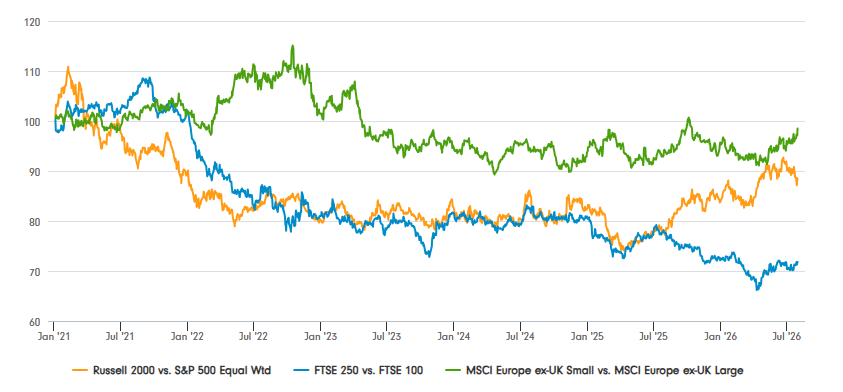
Small and mid-cap companies have spent several years in the shadow of mega-cap equities. Investor positioning in this segment remains subdued and valuations are close to multi-decade lows relative to large-caps, although this has shown signs of bottoming out over recent months. US smaller companies also tend to be more domestically oriented, which may leave them less directly exposed to global macro disruption and geopolitical uncertainty.
Relative performance of small vs large-cap indices
Past performance is not a guide to the future.
Source: Fidelity International/Bloomberg, September 2026. Data retrieved from Bloomberg as at 31 July 2026.
The relative gains of small and mid-caps since the start of 2025 are due to a range of specific factors, but in general, the headwinds that previously weighed on the segment are beginning to fade. Smaller companies were particularly exposed to the sharp increase in borrowing costs during 2022 and 2023, but many have now absorbed a substantial part of that adjustment, and future rate hikes will likely have a lessened impact. In contrast, some larger companies face the prospect of refinancing old low-cost fixed-rate debt in a higher rate environment, creating a potentially meaningful increase in interest expense.
Labour-cost pressures have also moderated. US wage growth has declined materially from its 2022 peak, reducing pressure on margins. Over time, greater use of AI and automation could provide an additional productivity benefit, particularly for more labour-intensive businesses.
As investors get to grips with a market that retains equity upside potential, but has become more complex, looking further down the capitalisation spectrum in the US could offer compelling opportunities. And if sentiment becomes more challenged, this area could offer greater levels of resilience than large-caps - as many investors are already underweight and valuations are at a relative discount, there would be less selling pressure. Overall, depressed valuations, improving fundamentals and light investor ownership could create a more attractive risk and reward profile than headline perceptions suggest.
The case for looking further down the capitalisation spectrum is also about the breadth of the opportunity. The US small and mid-cap universe contains more companies, receives less sell-side research coverage and exhibits greater dispersion in earnings expectations and stock returns than the large-cap market.
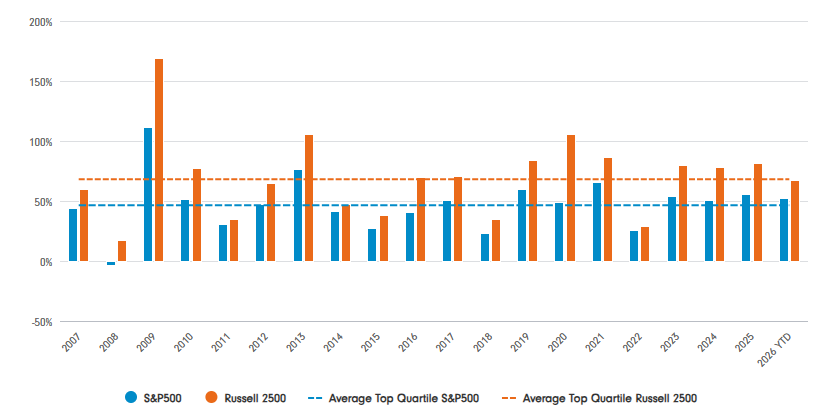
This can create a fertile hunting ground for fundamental research. Over each of the past 18 calendar years, the average performance of the top quartile of stocks in the Russell 2500 Index has exceeded that of the top quartile in the S&P 500 Index. This consistency illustrates an often-overlooked feature of the asset class: while small and mid-caps may experience periods of weaker index-level performance, they continue to generate a deep pool of high-conviction winners for investors that have the tools to identify them.
Average performance of top quartile (by count) for US small and mid-cap and US large-cap stocks
Past performance is not a guide to the future.
Source: Fidelity International, Bloomberg as of 31 July 2026.
The Fidelity US Fundamental Small-Mid Cap UCITS ETF was designed to capture these inefficiencies through a high-conviction active investment approach. The investment process brings together insights from a range of Fidelity Investments portfolio managers, drawing on different investment styles and perspectives across the firm’s research platform.
A proprietary framework aggregates these views to identify stocks where the underlying managers have the greatest conviction. Portfolio construction then combines this fundamental insight with a disciplined, systematic process which efficiently manages any unintended style or sector exposures.
The resulting portfolio provides access to a range of research-led ideas while reducing reliance on any single portfolio manager. Its semi-transparent ETF structure is also designed to protect proprietary investment insights, an important consideration in less liquid and less intensively researched areas of the market, and helping to ensure efficient trade pricing.
Within a broader equity allocation, the strategy can help diversify exposure away from mega-cap stocks, increase participation in domestically oriented areas of the US economy and create access to company-specific growth opportunities that may not be well represented in large-cap indices.
Since the Fundamental Equity ETF range was launched over one year ago in September 2025, it has remained aligned with its objective of capturing the breadth of opportunities across the US small and mid-cap universe. Despite periods of volatility, the strategy has delivered strong outcomes, outperforming the Russell 2500 Index since inception.
In terms of performance drivers, the portfolio has benefited from exposure to companies positioned to capitalise on rising AI-related capital expenditure, particularly across memory, semiconductors, and digital infrastructure. These have been among the highest-conviction ideas identified by the underlying portfolio managers and, as a result, have featured prominently among the ETF’s largest active positions. Lumentum has been the standout performer since inception, supported by surging demand for its datacom lasers and optical transceivers as hyperscale providers accelerated investment in AI infrastructure. Seagate, a non-benchmark holding, also generated strong returns, benefiting from a sustained increase in demand for high-capacity hard disk drives linked to the AI investment cycle.
One year on, we have already witnessed a variety of sentiment shifts towards the US market which has underscored the importance of research-powered investing. The past year has provided an early illustration of how active management and disciplined stock selection can uncover differentiated opportunities beyond the largest US companies. With market concentration elevated and valuations increasingly dispersed, looking further down the capitalisation spectrum may help investors build broader and more balanced US equity exposure.
Rolling 12-month performance
| 1 year ending | 03/09/22 | 03/09/23 | 03/09/24 | 03/09/25 | 03/09/26 |
|---|---|---|---|---|---|
|
Fidelity US Fundamental Small-Mid Cap UCITS ETF |
- |
- |
- |
- |
26.9% |
|
Russell 2500 Index |
- |
- |
- |
- |
26.5% |
Past performance is not indicative of future results.
Source: Fidelity International, Bloomberg. Rolling 12 month returns (%) in USD, retrieved as at 03 September 2026. Basis: nav-nav, income reinvested in relevant base currency (USD); returns shown net of fees.

Important information
Investment objective - The Fidelity US Fundamental Small-Mid Cap UCITS ETF aims to achieve long-term capital growth by actively investing in a portfolio primarily made up of equity securities of companies with small-to-mid market capitalisations domiciled, or exercising the predominant part of their economic activity, in the United States.
This information must not be reproduced or circulated without prior permission. This information does not constitute investment advice unless specifically agreed in a formal communication. Fidelity International refers to the group of companies which form the global investment management organisation that provides information on products and services in designated jurisdictions outside of North America. Fidelity, Fidelity International, the Fidelity International logo and F symbol are registered trademarks of FIL Limited. FIL Limited and FMR LLC are separate companies with some shareholders in common.
Fidelity UCITS ICAV is registered in Ireland pursuant to the Irish Collective Asset-management Vehicles Act 2015 and is authorised by the Central Bank of Ireland as a UCITS. FIL Investment Management (Luxembourg) S.à r.l. reserves the right to terminate the arrangements made for the marketing of the sub-fund and/or its shares in accordance with Article 93a of Directive 2009/65/EC and Article 32a of Directive 2011/61/EU. Prior notice of this cessation will be made in Ireland.
This communication is not directed at, and must not be acted upon by persons inside the United States and is otherwise only directed at persons residing in jurisdictions where the relevant funds are authorised for distribution or where no such authorisation is required. We recommend that you obtain detailed information before taking any investment decision. Investments should be made on the basis of the current prospectus and the KID (key information document) or KIID (key investor information document), as applicable. These documents, the current annual and semi-annual reports as well as information on investor rights are available in the languages and on the websites indicated below.
Austria: Prospectus and KID in English/German and Complaints policy in German on www.fidelity.at. Issued by FIL Investment Management (Luxembourg) S.à r.l., authorised and supervised by the CSSF (Commission de Surveillance du Secteur Financier).
Czech Republic: Prospectus and KID in English/Czech and Complaints policy in Czech on www.fidelity.cz. Issued by FIL Investment Management (Luxembourg) S.à r.l., authorised and supervised by the CSSF (Commission de Surveillance du Secteur Financier).
Denmark: Prospectus in English, KID in English/Danish and Complaints policy in Danish on www.fidelity.dk. Issued by FIL Investment Management (Luxembourg) S.à r.l., authorised and supervised by the CSSF (Commission de Surveillance du Secteur Financier).
Finland: Prospectus in English, KID in English/Finnish and Complaints policy in Finnish on www.fidelity.fi. Issued by FIL Investment Management (Luxembourg) S.à r.l., authorised and supervised by the CSSF (Commission de Surveillance du Secteur Financier).
France: Prospectus, KID and Complaints policy in French on www.fidelity.fr. This document is available in French upon request. If you do not wish to receive documents in English dedicated to Professional, please contact your Fidelity contact. Issued in France by FIL Gestion, authorised and supervised by the AMF (Autorité des Marchés Financiers) N°GP03-004, 21 Avenue Kléber, 75116 Paris.
Germany: Prospectus in English, KID and Complaints policy in German on www.fidelity.de/anlegerinformationen, www.fidelity.de/beschwerdemanagement/ and www.fidelity.lu/complaints-handling-policy. Any performance disclosure is not compliant with German regulations regarding retail clients and must therefore not be handed out to these. Issued for German Wholesale clients by FIL Investments Services GmbH / for German Pension clients by FIL Finance Services GmbH (Kastanienhöhe 1, 61476 Kronberg im Taunus). Issued for German Institutional clients by FIL Investment Management (Luxembourg) S.à r.l., 2a, rue Albert Borschette BP 2174 L-1021 Luxembourg.
Hungary: Prospectus in English, KID in English/Hungarian and Complaints policy in Hungarian on www.fidelity.co.hu. Issued by FIL Investment Management (Luxembourg) S.à r.l., authorised and supervised by the CSSF (Commission de Surveillance du Secteur Financier).
Ireland: Prospectus, KID and Complaints policy in English on www.fidelity.ie. Issued by FIL Investment Management (Luxembourg) S.à r.l., authorised and supervised by the CSSF (Commission de Surveillance du Secteur Financier).
Italy: Prospectus, KID and Complaints policy in Italian on www.fidelity-italia.it. Information is also available in Italian at Consob. Issued by FIL Investment Management (Luxembourg) S.à r.l., authorised and supervised by the CSSF (Commission de Surveillance du Secteur Financier).
Liechtenstein: Prospectus, KID and Complaints policy in English/German on www.fidelity.li. Issued by FIL Investment Management (Luxembourg) S.à r.l., authorised and supervised by the CSSF (Commission de Surveillance du Secteur Financier).
Luxembourg: Prospectus and KID in English/French/German and Complaints policy in English on www.fidelity.lu. Issued by FIL Investment Management (Luxembourg) S.à r.l., authorised and supervised by the CSSF (Commission de Surveillance du Secteur Financier).
Netherlands: Prospectus, KID and Complaints policy in Dutch on www.fidelity.nl. Issued by FIL Investment Management (Luxembourg) S.à r.l., authorised and supervised by the CSSF (Commission de Surveillance du Secteur Financier).
Norway: Prospectus in English, KID in English/Norwegian and Complaints policy in Norwegian on www.fidelity.no. Issued by FIL Investment Management (Luxembourg) S.à r.l., authorised and supervised by the CSSF (Commission de Surveillance du Secteur Financier).
Portugal: Prospectus in English, KID and Complaints policy in Portuguese on www.fidelity.pt. Fidelity Funds is registered with the CMVM and the legal documents can be obtained from locally authorised distributors. Issued by FIL Investment Management (Luxembourg) S.à r.l., authorised and supervised by the CSSF (Commission de Surveillance du Secteur Financier).
Slovakia: Prospectus in English, KID in English/Slovakian and Complaints policy in Slovakian on www.fidelity.sk. Issued by FIL Investment Management (Luxembourg) S.à r.l., authorised and supervised by the CSSF (Commission de Surveillance du Secteur Financier).
Spain: Prospectus and KID in English/Spanish and Complaints policy in Spanish on www.fondosfidelity.es. The distributing and depositary entities are, respectively, FIL Investment Management (Luxembourg) S.à r.l. and Brown Brothers Harriman (Luxembourg) S.C.A. Fidelity Funds and FAST are registered for marketing in Spain in the register of Foreign Collective Investment Undertakings of the CNMV under registration numbers 124 and 649 respectively, where detailed information on the local distributors can be obtained. Issued by FIL Investment Management (Luxembourg) S.à r.l., authorised and supervised by the CSSF (Commission de Surveillance du Secteur Financier).
Sweden: Prospectus in English, KID in English/Swedish and Complaints policy in Swedish on www.fidelity.se. Issued by FIL Investment Management (Luxembourg) S.à r.l., authorised and supervised by the CSSF (Commission de Surveillance du Secteur Financier).
Switzerland: Prospectus and KID in English/German/French and Complaints policy in German/English on www.fidelity.ch and from the representative and paying agent in Switzerland, BNP Paribas, Paris, succursale de Zurich, Selnaustrasse 16, 8002 Zurich. Fidelity undertakes the financial services of purchasing and/or selling financial instruments within the meaning of the Financial Services Act (FinSA). Fidelity is not required to assess the appropriateness and suitability under FinSA. The information provided constitutes an advertisement. Issued by FIL Investment Switzerland AG.
UK: The Key Investor Information Document (KIID) is available in English and can be obtained from our website at www.fidelityinternational.com. The Prospectus may also be obtained from Fidelity. Issued by FIL Pensions Management. Authorised and regulated by the Financial Conduct Authority.
The Fidelity US Fundamental ETFs are listed on Xetra, LSE, SIX and Borsa Italiana.

GCT260926EUR