

01 Sept 2026
Despite the return of higher energy prices, we see little evidence that they are feeding into broader inflation - however, markets continue to price in expectations of further rate hikes across several regions. Meanwhile, resilient growth across many regions provides a potentially more supportive backdrop, but one that remains challenging to navigate. Mike Riddell, Portfolio Manager of the Fidelity Strategic Bond Fund, discusses the key drivers shaping rates markets and where he sees the risks and opportunities for bond investors.
Despite higher energy prices, we have seen little evidence so far that they are feeding into broader inflation. At the same time, markets continue to price further rate hikes across several regions. This supports our long duration stance, particularly at the front end of several curves. Growth has held up across many regions, while the US labour market has shown signs of weakening.
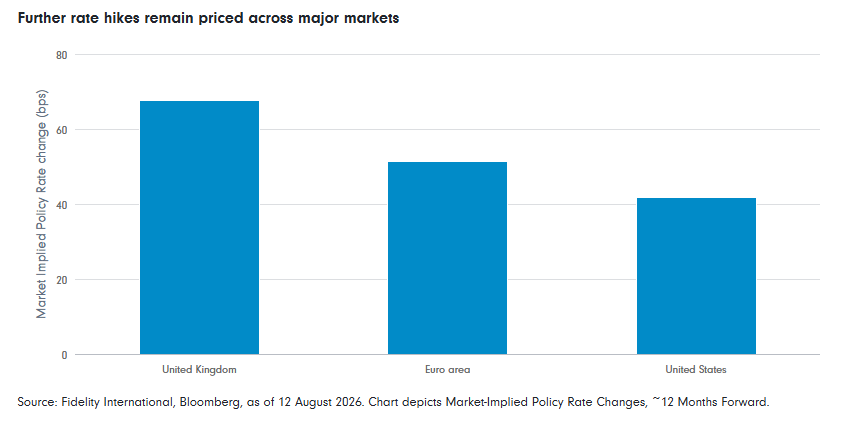
We remain long duration overall, with a particular preference for the front end of several curves.
In the US, weakening labour-market indicators provide an additional reason to own duration. Australia also remains a key allocation, supported by softer inflation data and weakness in the housing market.
We added UK duration following the recent sell-off. While growth has held up, markets continue to price further tightening despite limited evidence so far of broader inflation effects. We also favour Canadian duration, while remaining cautious on European rates given resilient growth and the region’s sensitivity to energy prices.
Within emerging-market local rates, we trimmed Brazil following the recent rally and ahead of election-related uncertainty, while retaining some exposure given still-high real yields.
We reduced short-dated US inflation-linked exposure following the sharp downside surprise in US CPI, but continue to retain inflation exposure should price pressures rise again.
So far, market-based inflation expectations have remained relatively anchored, while food inflation has continued to come in below expectations across regions. This has helped limit the extent to which higher energy costs are feeding into broader inflation.
However, crude oil, refined products and European gas prices have risen again, creating renewed upside risks to inflation. Market-based inflation expectations have remained relatively anchored, but we continue to retain inflation protection given these risks.
Within currencies, we took profits on our long JPY position after intervention from the Japanese authorities drove a material appreciation in the currency.
We subsequently moved short JPY against EUR. In our view, sustained JPY strength would likely require a more hawkish Bank of Japan, while Eurozone growth has held up relatively well.
We have also become more constructive on emerging-market currencies as US data has softened. We increased our USD short, trimmed BRL ahead of Brazil’s presidential election and added COP exposure.
We continue to maintain a cautious stance in credit, as valuations remain unattractive and spreads offer limited compensation should growth or risk sentiment weaken. Despite higher energy prices, government bond volatility and continued geopolitical uncertainty, credit spreads remain close to historically tight levels. We therefore see limited value in adding broad credit risk at current valuations.
Past performance does not predict future returns
| Standard period fund performance* (GBP, gross of fees) | 1 month | 3 months | 6 months | YTD |
|---|---|---|---|---|
|
Fidelity Strategic Bond* |
-0.8% |
0.6% |
1.9% |
4.4% |
|
Index** |
-1.0% |
0.0% |
-0.1% |
2.2% |

Source: Fidelity International, 31 July 2026. *Fund performance reflects FF Strategic Bond Y-ACC-Euro (hedged) shares, nav-nav with income reinvested, gross of fees (Ongoing Charges Figure of 0.79% per year applies to Y shares). The Y-ACC-Euro (hedged) share class was launched on 8 March 2011. **Index and relative returns reflect the Strategic Asset Allocation Blend (ICE BofA Q944 Custom Index) until 28 April 2025 and thereafter the Bloomberg Global Aggregate Total Return Index (Currency hedged). Performance data is quoted at the fund's official valuation point. Please note that numbers may not sum exactly to totals shown due to the rounding of figures. Please also note: FF Strategic Bond fund’s name was changed on 19 July 2024 (formerly the FF Sustainable Strategic Bond Fund).
Important information
This information is for investment professionals only and should not be relied upon by private investors. Past performance is not a reliable indicator of future returns. Investors should note that the views expressed may no longer be current and may have already been acted upon. Changes in currency exchange rates may affect the value of investments in overseas markets. Fidelity’s range of fixed income funds can use financial derivative instruments for investment purposes, which may expose them to a higher degree of risk and can cause investments to experience larger than average price fluctuations. The value of bonds is influenced by movements in interest rates and bond yields. If interest rates and so bond yields rise, bond prices tend to fall, and vice versa. The price of bonds with a longer lifetime until maturity is generally more sensitive to interest rate movements than those with a shorter lifetime to maturity. The risk of default is based on the issuers ability to make interest payments and to repay the loan at maturity. Default risk may therefore vary between government issuers as well as between different corporate issuers. Due to the greater possibility of default, an investment in a corporate bond is generally less secure than an investment in government bonds. Reference in this document to specific securities should not be interpreted as a recommendation to buy or sell these securities and is only included for illustration purposes.
UK: The Key Investor Information Document (KIID) is available in English and can be obtained from our website at www.fidelityinternational.com. The Prospectus may also be obtained from Fidelity. Issued by FIL Pensions Management. Authorised and regulated by the Financial Conduct Authority.
FIPM: 10782