Geopolitical tensions have once again brought the energy sector into focus. In the latest edition of our Analyst Spotlight series, Portfolio Specialist Fatna Chelihi sat down with Investment Analyst Andy Peters to discuss why the investment opportunity may lie beyond near-term oil price movements.
Andy covers oilfield services, midstream and refining companies and is responsible for an investment sleeve in our U.S. Structured Research Equity strategy. Andy has 14 years of investment experience, including 12 with T. Rowe Price. In his early years at the firm, he had the benefit of working with a Portfolio Manager who was covering oilfield services back in the late 80s. During the discussion, he explained why he believes the energy sector is entering the early stages of a new multi-year commodity cycle, outlined the distinct investment frameworks he applies across each subsector, and highlighted where T. Rowe Price’s fundamental research is uncovering differentiated investment opportunities.
The next energy cycle will be driven by where future supply comes from
- Andy believes the energy market is transitioning into the early stages of a new commodity bull market. While geopolitical events can influence prices in the short term, he believes the more important investment question is where future oil supply will come from over the next decade.
- For much of the last 15 years, U.S. shale was able to meet incremental global demand through rapid productivity improvements and falling development costs. Andy believes this dynamic is changing as shale basins mature and well productivity begins to decline.
- As producers increasingly move beyond their highest-quality acreage, sustaining production will require greater capital investment and a larger contribution from international and offshore developments. In Andy’s view, this represents a structural shift that could reshape capital allocation across the energy sector for years to come.
- Andy works closely with our E&P [Exploration and Production] analyst at T. Rowe Price to better understand well productivity, capital spending and supply dynamics across the upstream industry, helping identify where the next phase of investment is likely to emerge before it is fully reflected by the market.
Oilfield services stands to benefit as investment shifts globally
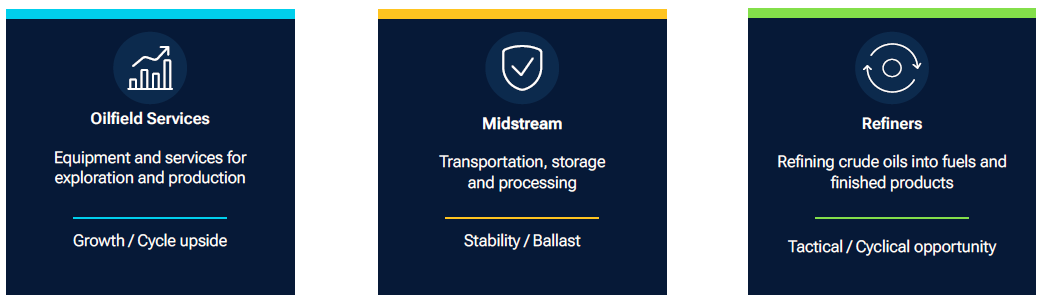
- Andy believes oilfield services offers the most attractive medium-term opportunity across his coverage universe and represents his largest overweight position.
- Unlike U.S. shale, international and offshore projects are more technically demanding, require significantly higher service intensity and typically generate stronger demand for companies with differentiated engineering capabilities.
- One of his highest conviction holdings is SLB, which generates the majority of its revenue outside the United States and is a global leader in reservoir characterisation and complex offshore
- developments. He believes the company’s technical leadership and global footprint position it to benefit as capital spending increasingly shifts toward international markets.
- In Andy’s view, exploration spending has fallen to unusually depressed levels after years of underinvestment. As exploration activity gradually normalises, he believes companies with leading exploration capabilities, such as SLB, can benefit from an additional long-term growth driver.
Selectivity remains important across the rest of the energy value chain
- While oilfield services offers the strongest upside in Andy’s view, he continues to apply distinct investment frameworks across each subsector in his coverage.
- Within refining, recent supply disruptions have supported refining margins, but stronger valuations have made the risk/reward less compelling. As a result, he is maintaining a more balanced positioning despite favourable industry fundamentals.
- In midstream, Andy focuses on companies with durable infrastructure assets capable of generating steady earnings growth through multiple commodity cycles rather than making large sector allocation calls.
- One example is Williams, whose Transco pipeline system connects some of the most attractive U.S. natural gas supply basins with major East Coast demand centres. Andy believes this difficult-to-replicate asset footprint provides a durable competitive advantage as LNG [Liquefied Natural Gas] exports, power demand and natural gas consumption continue to grow.
Long-term winners combine structural tailwinds with competitive advantages
- Andy believes correctly identifying the commodity cycle creates the opportunity set, but long-term investment success ultimately depends on owning companies with sustainable competitive advantages.
- Across oilfield services, his view is that SLB stands out for its technological leadership, international exposure and strong positioning in exploration and complex offshore developments.
- Within midstream, his thesis on Williams is that it benefits from an irreplaceable infrastructure network that connects advantaged supply and demand markets.
- In refining, Andy continues to favour Gulf Coast operators such as Valero and Marathon Petroleum, whose scale, advantaged crude sourcing and export capabilities provide structural cost advantages throughout the cycle, in his view.
- By combining bottom-up company research with long-term industry analysis, Andy’s investment framework seeks to identify businesses that are best positioned to create value throughout the energy cycle, rather than simply responding to short-term movements in commodity prices.
Fig.1: Each subsector plays a distinct role in Andy’s portfolio