


29 Sept 2026
For decades, stocks and bonds were the foundation of most investment portfolios. They offered liquidity, transparency, and efficient access to companies, governments, and economic growth. But the structure of global capital markets has changed. Public equity indexes have become more concentrated, and the benefit of diversifying into both stocks and bonds has become less predictable. At the same time, a growing share of business and investment activity now takes place away from public markets. For investors, public markets may represent only a fraction of the available opportunity set.
The question is... not whether private investments should replace public stocks and bonds, but how the two work together to help improve outcomes.
As private markets become a larger part of the investment landscape, they offer additional ways to pursue long‑term growth, income, and diversification in a portfolio. The question therefore is not whether private investments should replace public stocks and bonds, but how the two work together to help improve outcomes.
Institutional investors, including pension funds, endowments, foundations, and sovereign wealth funds, have long incorporated private market strategies into portfolio construction. Now, due to improvements in market infrastructure, individual investors are also gaining broader access to these opportunities.
Private markets expand the range of return drivers available in a long‑term portfolio by providing exposure to businesses, borrowers, cash flow structures, and economic drivers that differ from those represented in public stock and bond markets. At the same time, because private investments are generally less liquid and more complex than public investments, investors should pay close attention to a manager’s ability to select and oversee individual investments.
(Fig. 1) Assets under management, by strategy
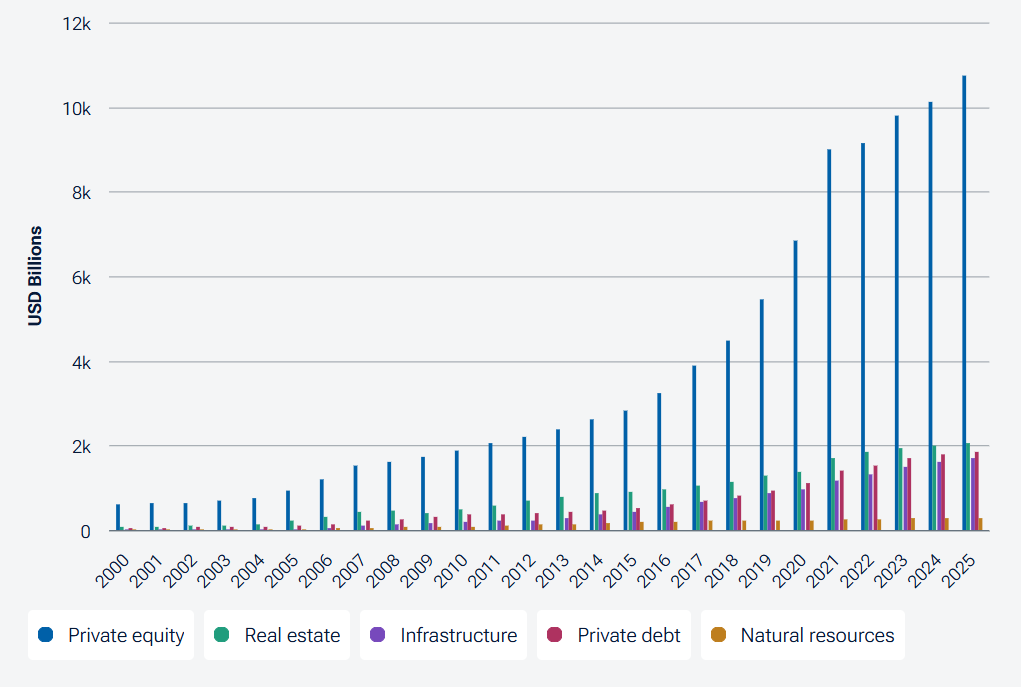
Source: Preqin.
Data as of December 31, 2025.
For office use only: 202609-5923882
Private markets broadly refer to investments that are not bought and sold on public exchanges. The “private markets” label covers several different investments.
Each strategy offers a different combination of benefits and risks, and can play a distinct role within a broader portfolio.
Private equity involves investing in companies that are not publicly traded. Depending on the strategy, managers may invest in established businesses, growing companies, or earlier‑stage enterprises. As a result, private equity can provide access to a broad universe of companies that are not available in public markets.
(Fig. 2) Different strategies that can play distinct roles
| Strategy | What it invests in | Potential role in portfolio |
|---|---|---|
| Private equity | Private companies | Long-term growth and appreciation |
| Private credit | Privately negotiated loans and other financing | Income and diversification from traditional fixed income |
| Real assets | Real estate and infrastructure | Income, diversification, and potential sensitivity to inflation |
Historically, one of the primary attractions of private equity has been its potential to generate higher long‑term returns than public equity markets over extended periods. This has been attributed to several factors, including the ability of managers to actively build value within portfolio companies—by supporting growth, strengthening operations, or repositioning the company—as well as the additional compensation investors may receive for committing capital over longer periods. However, focusing solely on excess returns may understate the broader opportunity.
Private equity provides access to businesses and business models that may be underrepresented—or simply unavailable—in public markets. Many companies today remain private through a larger portion of their growth cycle, allowing private investors to participate in value creation that historically may have occurred after a company became publicly listed. For example, between 1980 to 2000, the age of initial public offerings averaged 8.0 years. Since 2001, that average has increased to 11.3 years.1
The nature of private equity value creation has also evolved. Instead of simply purchasing shares and waiting for their value to rise, private equity managers design and implement detailed value creation plans. These may include working with company leadership to improve operations, pursuing new sources of growth, strengthening management, or helping the business adapt to change. This active ownership seeks to create positive results, but successful execution is not guaranteed.
(Fig. 3) Internal rate of return dispersion by strategy (2005 to 2020 vintages)
Source: Pitchbook. Data as of December 31, 2025. Past performance is not a guarantee or a reliable indicator of future results.
Private equity is less liquid, more complex, and often more expensive than public equity. These conditions can lead to a wide dispersion of outcomes across managers and investments. The ability to identify attractive companies, purchase them at appropriate valuations, support their development, and ultimately exit successfully can materially affect results. Manager selection therefore plays an especially important role.
Private credit refers to lending activity where the financial instruments are not issued or traded on public markets. A manager may lend directly to a business or against a pool of assets, provide debt for a real estate transaction, or finance an infrastructure project.
From a returns perspective, private credit is first and foremost about income generation. Because loans are negotiated directly, lenders may be able to customize terms for a particular borrower, including interest rates, collateral, repayment requirements, and different forms of downside protection. These features help compensate investors for accepting credit risk, complexity, and reduced liquidity.
Private lending is not new. What has changed is the growing role of investment managers and other nonbank lenders in providing capital to businesses. Regulation, balance‑sheet priorities, and shifts in bank risk tolerance have pushed some borrowers toward private lenders, which may offer speed, certainty, confidentiality, or customized terms that are difficult to obtain through a bank loan or public bond issue.
For investors, that shift has broadened the range of income‑producing opportunities available beyond public bond markets.
Private credit can offer higher income than some traditional fixed income investments, in part because investors accept additional credit risk, complexity, and limited liquidity. Negotiated terms provide lenders with key protections, but they do not eliminate credit risk.
(Fig. 4) Dry powder
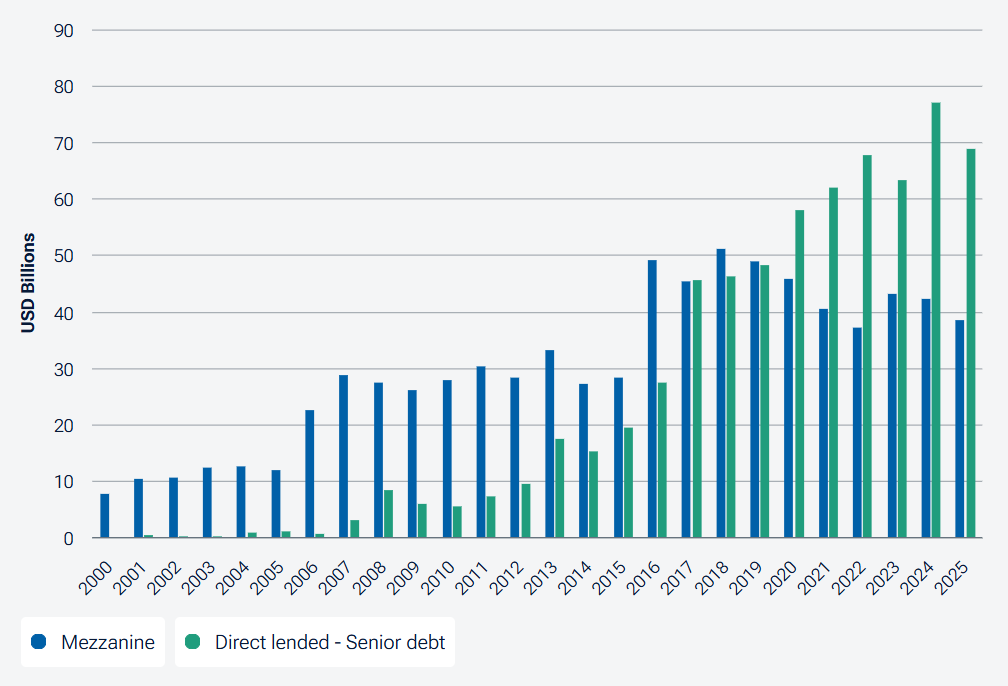
As of December 31, 2025. Data representative of North America only.
Source: Preqin.
For office use only: 202609-5923882
Within a diversified portfolio, private credit may complement public fixed income by expanding access to different borrowers and sources of income. However, results will depend heavily on disciplined underwriting and ongoing oversight.
Real assets include investments in physical property and infrastructure. Typical investments in this category include apartment buildings, student housing, logistics facilities, broadband networks, energy infrastructure, hospitals, transportation assets, and data centers—assets that support everyday economic activity. These assets aim to provide income, appreciation, diversification, and, in some cases, help mitigate the effects of inflation.
Examples of real assets
Real asset returns come from income, appreciation, or a combination of both. One of the defining characteristics of real assets is their ability to generate cash flows tied to underlying economic activity. Examples include rental income from a property, contractual payments from infrastructure assets, and revenues linked to the use of essential services Because those cash flows arise from physical assets and operating businesses, their return drivers differ from those of traditional stocks and bonds.
In response to market environments where inflation is running high, some real assets may be able to adjust their revenues as prices rise. Property owners may reset rents when leases renew, while certain infrastructure contracts may include provisions that link payments to inflation. Other assets may benefit when the cost of replacing or building similar properties and infrastructure increases.
However, long‑term fixed contracts, limits on rent increases, rising operating expenses, higher financing costs, or weak demand can reduce this benefit. The degree of inflation protection therefore depends on the specific asset, its contractual terms, and the manager’s ability to operate it effectively.
Real estate and infrastructure should not be viewed as a single risk category. Results may be affected by property demand, tenant or customer quality, construction costs, regulation, environmental requirements, leverage, and changes in interest rates. The risks may also differ substantially between an established, income‑producing asset and a new development.
Careful selection can help investors target the characteristics they seek, but real assets still remain subject to loss and may be difficult to sell.
For many investors, real assets represent an opportunity to gain exposure to some of the most enduring themes in the economy while pursuing enhanced diversification and portfolio resilience.
Private markets can expand the opportunity set, but investors should pay close attention to some of the risks:
Private markets do not eliminate investment risk or market cycles. Relative to public markets, they change where risks reside, how those risks are managed, and how quickly they become visible.
(Fig. 5) Infrastructure investment (January 2007–December 2040)
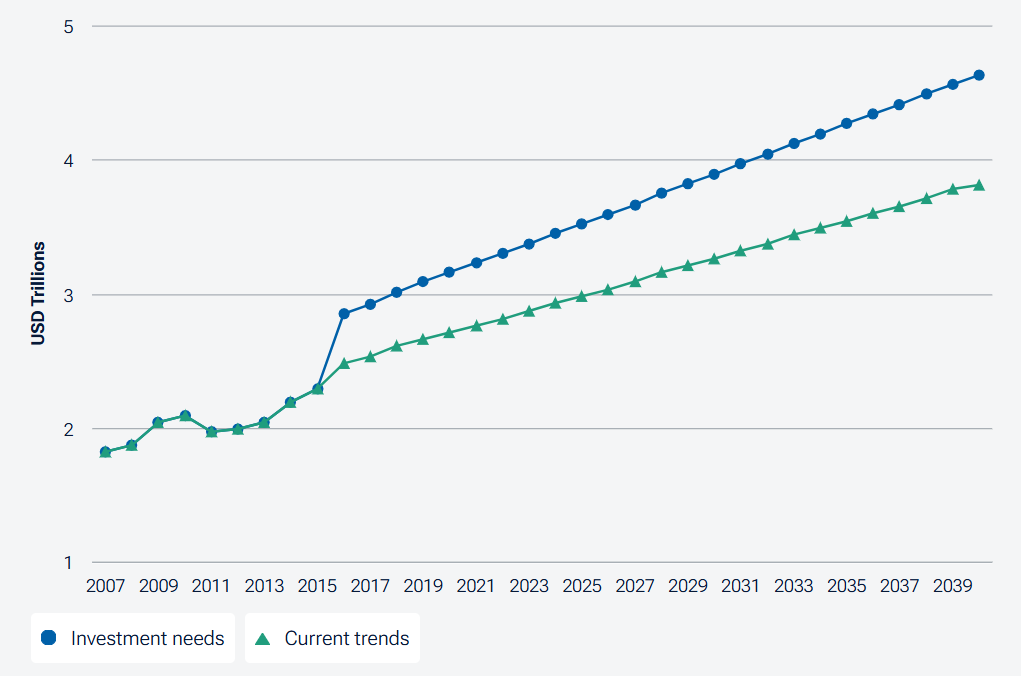
As of April 2025.Source:
The Global Infrastructure Hub, Global Infrastructure Outlook, World Economic Forum.
For office use only: 202609-5923882
Private markets are becoming more relevant as companies, assets, and projects increasingly raise capital outside public markets. The potential benefits of private markets—a broader set of tools for pursuing growth, income, and diversification—come with meaningful trade‑offs. Private investments are generally less liquid, more complex, and more dependent on manager skill.
As access broadens, the importance of selection increases. Research, judgment, selectivity, and portfolio construction remain essential to prudent portfolio construction. The appropriate role and size of an allocation to private markets will vary by investor and should accurately reflect their objectives, time horizon, liquidity needs, and the ability to tolerate periods of limited access to capital.
Before investing, investors should consult with their financial advisor about a private market allocation that fits within their broader financial plan. The goal is not to replace public markets, but to determine how public and private assets can work together to pursue improved outcomes.
1 Source: Jay R. Ritter, “Initial Public Offerings: Median Age of IPOs Through 2025,” University of Florida (data as of December 24, 2025).
This content is intended for investment professionals only. Private funds referenced herein are not available for sale in all jurisdictions or to all investors.
Risks
Investments in private markets are speculative and involve a substantial degree of risk, including the possible loss of all or a substantial portion of an investment. Private market investments may be illiquid, difficult to value and subject to restrictions on transfer, and there may be no readily available secondary market. They may also employ leverage or other investment techniques that can increase the risk of loss. Fees and expenses associated with private market investments may be higher than those of traditional investments and will reduce investment returns. Private market investments may not be suitable for all investors and generally require a long‑term investment horizon and the ability to tolerate limited liquidity and substantial fluctuations in value. Investors should carefully consider their investment objectives, financial circumstances, risk tolerance and the specific risks of an investment before investing.
Unless otherwise noted, all currencies mentioned are in US Dollars.
Additional Disclosure
For U.S. investors, visit troweprice.com/glossary for definitions of financial terms.
Please see vendor indices for more information, including definitions and source data: troweprice.com/marketdata.
Important Information
Outside of the United States, this is intended for investment professional use only. Not for further distribution. This material is being furnished for informational and/or marketing purposes only and does not constitute an offer, recommendation, advice, or solicitation to sell or buy any security. Prospective investors should seek independent legal, financial and tax advice before making any investment decision. T. Rowe Price group of companies including T. Rowe Price Associates, Inc. and/or its affiliates receive revenue from T. Rowe Price investment products and services.
Past performance is not a guarantee or a reliable indicator of future results. All investments involve risk, including possible loss of principal. Information presented has been obtained from sources believed to be reliable, however, we cannot guarantee the accuracy or completeness. The views contained herein are those of the author(s), are as of August 2026, are subject to change, and may differ from the views of other T. Rowe Price Group companies and/or associates. Under no circumstances should the material, in whole or in part, be copied or redistributed without consent from T. Rowe Price.
All charts and tables are shown for illustrative purposes only. Actual future outcomes may differ materially from any estimates or forward looking statements provided.
The material is not intended for use by persons in jurisdictions which prohibit or restrict the distribution of the material and in certain countries the material is provided upon specific request.
Australia—Issued by T. Rowe Price Australia Limited (ABN: 13 620 668 895 and AFSL: 503741), Level 28, Governor Phillip Tower, 1 Farrer Place, Sydney NSW 2000, Australia. For Wholesale Clients only.
Canada—Issued in Canada by T. Rowe Price (Canada), Inc. T. Rowe Price (Canada), Inc.’s investment management services are only available to non‑individual Accredited Investors and non‑individual Permitted Clients as defined under National Instrument 45‑106 and National Instrument 31‑103, respectively. T. Rowe Price (Canada), Inc. enters into written delegation agreements with affiliates to provide investment management services.
DIFC—Issued in the Dubai International Financial Centre by T. Rowe Price International Ltd which is regulated by the Dubai Financial Services Authority as a Representative Office. For Professional Clients only.
EEA—This material is issued and approved by T. Rowe Price (Luxembourg) Management S.à r.l. 35 Boulevard du Prince Henri L‑1724 Luxembourg which is authorised and regulated by the Luxembourg Commission de Surveillance du Secteur Financier. For Professional Clients only.
New Zealand—Issued by T. Rowe Price Australia Limited (ABN: 13 620 668 895 and AFSL: 503741), Level 28, Governor Phillip Tower, 1 Farrer Place, Sydney NSW 2000, Australia. No Interests are offered to the public. Accordingly, the Interests may not, directly or indirectly, be offered, sold or delivered in New Zealand, nor may any offering document or advertisement in relation to any offer of the Interests be distributed in New Zealand, other than in circumstances where there is no contravention of the Financial Markets Conduct Act 2013.
Switzerland—Issued in Switzerland by T. Rowe Price (Switzerland) GmbH, Talstrasse 65, 6th Floor, 8001 Zurich, Switzerland. For Qualified Investors only.
UK—This material is issued and approved by T. Rowe Price International Ltd, Warwick Court, 5 Paternoster Square, London EC4M 7DX which is authorised and regulated by the UK Financial Conduct Authority. For Professional Clients only.
USA—Issued in the USA by T. Rowe Price Investment Services, Inc., distributor and T. Rowe Price Associates, Inc., investment adviser, 1307 Point Street, Baltimore, MD 21231, which are regulated by the Financial Industry Regulatory Authority and the U.S. Securities and Exchange Commission, respectively.
Unless otherwise indicated, this material is issued and approved by T. Rowe Price International Ltd, Warwick Court, 5 Paternoster Square, London EC4M 7DX which is authorised and regulated by the UK Financial Conduct Authority. For Professional Clients only.
© 2026 T. Rowe Price. All Rights Reserved. T. Rowe Price, INVEST WITH CONFIDENCE, the Bighorn Sheep design, and related indicators (see troweprice.com/ip) are trademarks of T. Rowe Price Group, Inc. All other trademarks are the property of their respective owners. Use does not imply endorsement, sponsorship, or affiliation of T. Rowe Price with any of the trademark owners.
