


12 Oct 2026
The US equity market is going through a transition. Although we expect artificial intelligence (AI) to continue driving the market, its impact is evolving. Meanwhile, other factors are exerting their influence, from higher bond yields to momentum-driven shifts, to signs of stronger earnings growth outside the tech sector.
These themes all have the potential to boost returns for some stocks and hinder the prospects of others, creating a broader opportunity set for strategies that can take long and short positions, such as 130/30 funds. We believe the additional flexibility could prove particularly valuable in current market conditions.
The Artemis US Extended Alpha strategy is a 130/30 equity strategy that supplements its extended long portfolio with a short book. To be clear, it’s not a market neutral or absolute return fund; we are trying to outperform the S&P 500. Our net exposure (longs minus shorts) is typically 85-110%, depending on market conditions1.
What shorting gives us is an extra dimension, with the potential to deliver additional returns. (As evidence of this, the short book added alpha in eight of the 10 quarters to 30 June 2026.2) It also allows us greater flexibility to respond to changing market dynamics.
Shorting can be advantageous even when markets are delivering strong returns. A rising index does not necessarily mean most stocks rise with it. In 2025, against a backdrop of the S&P 500 rising almost 18%3, we had more than 30 shorts which were down over the year.
The market continues to present plenty of ideas for our short book. A range of American companies are facing challenges such as overcapacity, increased competition, a failure to meet dangerously high expectations or AI disrupting their business models.
The first half of 2026 saw the market hit the sell button aggressively on any stocks or sectors deemed to be at risk from AI. Areas such as software, data and IT services (which had historically been seen as having large ‘moats’ protecting their businesses) were feared to be under attack from new competition or people using models such as ChatGPT to develop their own data or software. Announcements from frontier AI company Anthropic that it had created new software challenging legal, finance and enterprise software products drove a frenzy on social media platforms.
The irony is that whilst the market has taken a ‘shoot first, ask questions later’ approach – sending stocks in the firing line down to (in some cases) unprecedented valuations – the impact on growth or fundamentals, for most companies, is yet to be seen.
We have taken the opportunity to add to some impacted stocks (longs), such as Jones Lang LaSalle, S&P Global and Visa, where we believe AI-related concerns are overdone. Moreover we have closed many of our IT services shorts, even if we still believe pricing compression is a material risk, because the stocks have already taken a big pummelling. Lastly, we have used weakness in the software sector to bring in some names that could benefit from increased use of AI agents, such as Twilio.
On the other hand, whilst our positions in AI-related beneficiaries in the semiconductor and hardware spaces performed well earlier this year, we have taken this exposure down towards what we believe is a neutral weighting. We still think there are pinch points where demand exceeds supply (such as optical and power semiconductors, and memory chips). We do feel, however, that in some cases share prices may have become too extended.
The second market shift involves interest rates. Conflict in the Middle East has pushed up oil prices, helping to keep inflation stubbornly high, curtailing the Federal Reserve’s ability to cut interest rates. Long-dated government bond yields have hit multi-year highs, which could put pressure on economic growth going forward.
As a result, the share prices of some companies in interest-rate-sensitive areas, such as housebuilding, construction and mortgage lending, have been knocked back. We have shorted some of these, but we are long others where we think share prices have discounted a lot of bad news, offer value and could rise significantly if interest rates move lower.
Our next move will probably involve adding to these positions, such as Rocket Companies (homeownership) and Wayfair (furniture), as and when see inflation pressures moderate and a pathway to more supportive lower yields.
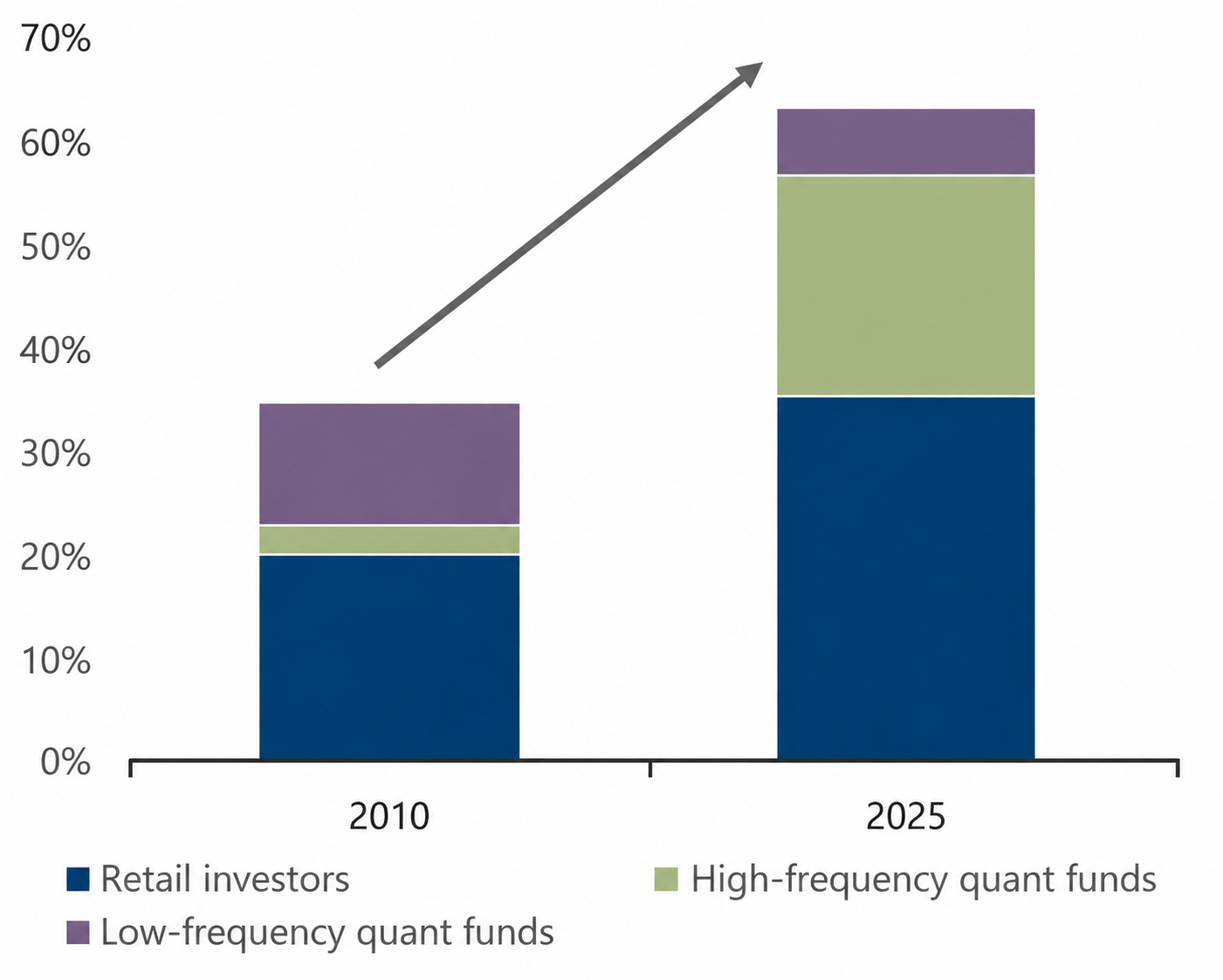
Market structure has changed too. Retail investors and quantitative strategies now account for more than 60% of trading volumes in the US. As a result of these types of investors trading on themes, sentiment and short-term news flow, share prices sometimes drift away from their intrinsic value, which gives active managers like us an opportunity.
Source: Artemis, Empirical Research Partners, ChatGPT as at 31 Dec 2025
In recent years, AI stocks have led the S&P 500 upwards but many other areas have struggled due to higher-for-longer interest rates, tariffs, conflict in the Middle East and rising oil prices. Apart from some banks and energy stocks, the pool of winners has been shallow.
However, we are starting to see a recovery in earnings growth across a broader range of sectors, which was evident during the second quarter earnings season. If this continues, fund managers would have more places to generate returns on the long side.
Taken together, these four shifts (AI, interest rates, momentum and broadening) point to a US equity market containing a wide range of winners and losers. Having the ability to back companies we expect to prosper and also express a negative view on those facing challenges gives us a broader opportunity set and, we believe, more potential to generate alpha.
1 Source: Artemis as at 31 July 2026
2 Source: Artemis to 30 June 2026
3 The S&P 500 index generated a total return of 17.9% in US dollar terms in 2025; source: Lipper Limited to 31 December 2025
FOR PROFESSIONAL INVESTORS AND/OR QUALIFIED INVESTORS AND/OR FINANCIAL INTERMEDIARIES ONLY. NOT FOR USE WITH OR BY PRIVATE INVESTORS.
CAPITAL AT RISK. All financial investments involve taking risk and the value of your investment may go down as well as up. This means your investment is not guaranteed and you may not get back as much as you put in. Any income from the investment is also likely to vary and cannot be guaranteed.
This is a marketing communication. Before making any final investment decisions, and to understand the investment risks involved, refer to the fund prospectus (or in the case of investment trusts, Investor Disclosure Document and Articles of Association), available in English, and KIID/KID, available in English and in your local language depending on local country registration, available in the literature library.