

22 Sept 2026
UK equities have delivered strong returns and recently reached new highs, but compelling contrarian opportunities remain. With market leadership broadening, the backdrop for stock selection is becoming more supportive. Here, portfolio managers Alex Wright and Jonathan Winton highlight where they are seeing the most compelling opportunities across the market-cap spectrum.
We seek to capture investment opportunities through our disciplined, bottom-up investment approach. We look beyond prevailing market sentiment to identify unloved companies where we can understand the downside risk and work closely with Fidelity’s extensive analyst team to help us build conviction in the potential for positive change. This results in a diversified portfolio of individual turnaround stories at different stages of recovery, with stock selection ultimately driving portfolio positioning. Below, we explore some of the stock-specific opportunities currently shaping positioning across our four super sectors: Other GDP sensitives, financials, defensives and resources.
Opportunities broadly based (relative exposure %)
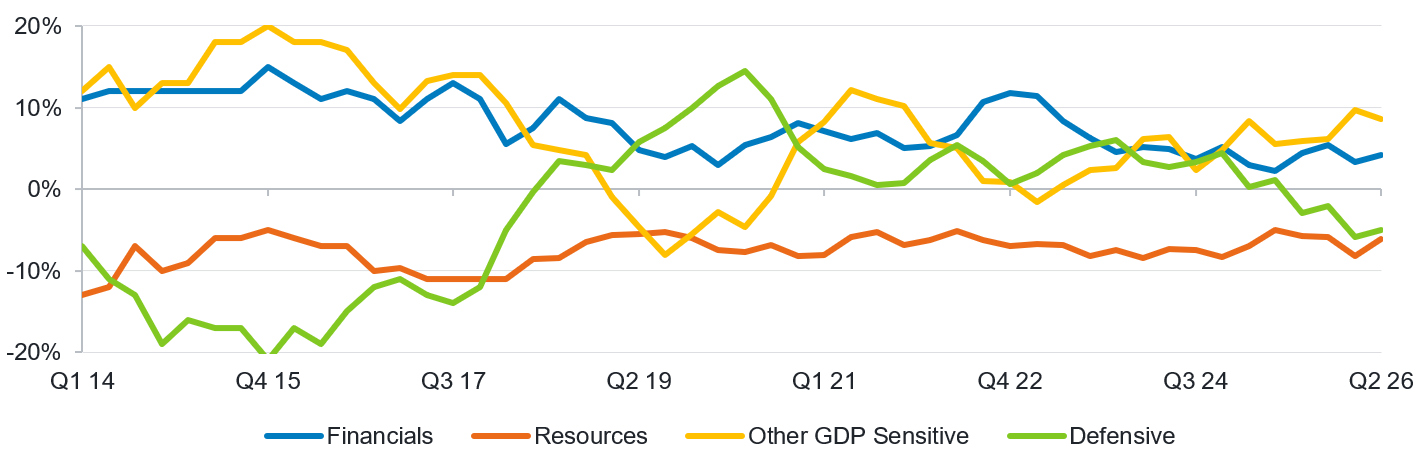
Source: Fidelity International, 30 June 2026. Fidelity Special Situations (OEIC) used as the representative portfolio. Data shown since the lead portfolio manager’s tenure began on 1 January 2014. Macro weightings chart for illustrative purposes only. Sector/stock categorisation is at Fidelity’s discretion. ¹Total return performance in GBP using FTSE indices to 31 August 2026.
Several economically sensitive industries have endured an unusually prolonged downturn, creating an attractive hunting ground for new ideas. For example, staffing companies have navigated one of the weakest recruitment environments in decades and trade at trough valuations. We hold positions such as Hays, PageGroup and SThree, where weak recruitment activity, concerns over AI-driven disruption and geopolitical uncertainty have weighed heavily on investor sentiment.
We increased our staffing exposure over the past 12 months as our research and site visits suggested the challenges facing the industry were predominantly cyclical, rather than structural. Importantly, these businesses have flexible, people-based cost structures and net-cash balance sheets, allowing them to adjust costs as activity falls while maintaining robust financial positions. This provides downside protection and the flexibility to weather an extended period of depressed recruitment activity, while offering substantial upside should a recovery in hiring activity materialise.
These positions rebounded sharply following upbeat trading results among staffing companies. The market reacted positively as they revealed gross profit ahead of consensus expectations, alongside signs of stabilisation across the UK, Asia-Pacific and US recruitment markets. Encouragingly, the latter two markets are also where AI adoption is arguably most advanced, reinforcing our view that the industry’s challenges are more cyclical in nature.
Banks are another area of opportunity. Exposure to the industry currently stands at one of the highest over our tenure, but holdings are diversified across a variety of geographies and business models. We started increasing exposure towards the end of 2021 as strengthening fundamentals and rising interest rates created a more supportive earnings environment, while valuations remained deeply discounted.
Banks have performed strongly since then, supported by earnings upgrades, improving returns on capital and significant capital distributions to shareholders. Yet we continue to see attractive value. Unlike the post-financial crisis period of near-zero interest rates, today’s interest rate environment allows banks to earn attractive margins on deposits and generate stronger returns on capital. Importantly, we do not make a precise call on the interest rate level, but we believe these businesses can generate solid returns across a relatively wide range of rate environments.
Against this backdrop, we have added to large domestic banks such as NatWest and Lloyds this year, which continue to trade at just 7–9x forward earnings. These stocks have performed strongly, but crucially, much of their share-price appreciation has been driven by earnings growth rather than multiple expansion, leaving valuations at meaningful discounts to longer-term history. We believe these businesses have resilient franchises and can continue to generate attractive returns, with current valuations still not fully recognising the strength of their fundamentals.
Resources: Glencore – more than a copper story
Diversified commodity portfolio
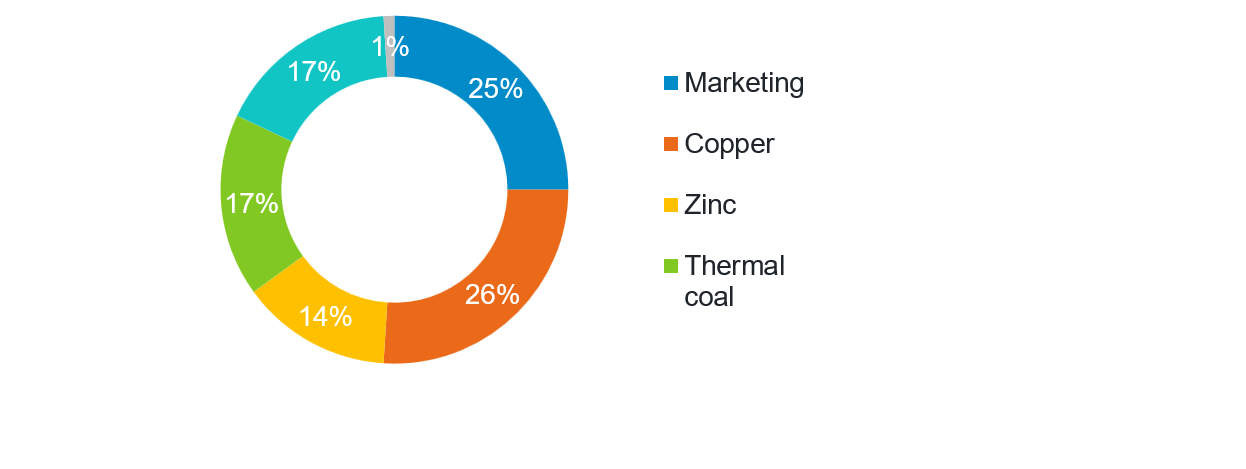
Source: Glencore, FY25 EBITDA breakdown.
We have consistently been underweight the resources sector, primarily reflecting the large benchmark weights of energy and mining companies and our selective, contrarian approach to stock selection. However, we continue to find stock-specific opportunities. Diversified mining and commodity marketing business Glencore is an example of where we see several potential drivers of positive change. We initiated a position in March 2025 following significant share-price weakness and large earnings downgrades. We were attracted by Glencore’s diversified commodity portfolio and, in particular, its meaningful exposure to copper. Our research indicated structural supply constraints and a supportive long-term outlook for the metal, and Glencore has a pipeline of projects that should position it to benefit from growing demand over time.
Since we built our position, Glencore has performed strongly as the market increasingly recognised the growth potential from copper, while recent takeover interest has further highlighted the embedded value within the company’s commodity portfolio. Importantly, the investment case has continued to evolve. We added opportunistically to the position this year. Unlike many other miners, where higher energy costs can weigh on profitability, Glencore's coal exposure provides a natural offset in an environment of higher gas prices, while its global commodity trading operation thrives in periods of heightened market volatility.
Several of our defensive holdings performed strongly last year, prompting us to take profits as valuations became less attractive. More recently, we recycled capital into new opportunities such as Bunzl, which was among the worst-performing stocks in the FTSE 100 last year. The company operates a global distribution business supplying everyday products that its customers need to run their operations, from food packaging and cleaning products to disposable gloves. Its relatively defensive revenues, strong returns on capital and acquisition strategy have historically commanded a premium valuation.
However, problems within its North American foodservice division caused earnings to disappoint and shares to de-rate materially. The company had centralised decision-making and shifted towards higher-margin own-brand products, but these changes ultimately affected customer relationships and resulted in market share losses. Importantly, the problems remained concentrated within a division representing only around 20% of the business, while the remaining operations continued to perform well.
Our research established confidence that these issues were temporary rather than structural. Working with Fidelity's analyst team, we conducted expert calls with former industry participants and competitors to test management's assessment of the failings and the credibility of the remedial steps to address them. Management has since reversed some of the changes and replaced the divisional leadership, providing identifiable catalysts for recovery. This combination of a significantly lower valuation, resilient underlying business and potential for self-help underpinned our decision to initiate a position.
Encouragingly, the turnaround has started to progress quicker than we initially expected, with recent trading showing an improvement in organic growth and its shares beginning to re-rate. While still early in the investment case, Bunzl illustrates the type of opportunity we seek: a fundamentally strong business where a specific and potentially reversible problem creates an attractive entry point, and where our research can help us gain conviction before the wider market fully recognises the potential for positive change.
The broadening of UK equities is an encouraging development. After a prolonged period in which large-caps dominated returns, improving participation from mid- and small-cap companies provides a more supportive backdrop for our investment approach and structural bias towards this part of the market.
Importantly, we continue to find compelling opportunities right across the UK market. Fidelity’s extensive analyst team is central to uncovering these ideas, helping us look beyond prevailing market sentiment and build conviction in the potential for positive change. Despite the strong performance of UK equities in recent years, the breadth of opportunities leaves us optimistic about the outlook for our contrarian approach.