

10 Nov 2026
Global equity markets remain volatile, with concentrated market leadership highlighting the importance of diversification. Portfolio manager Tristan Purcell examines how global equity income portfolios can offer defensive benefits and differentiated sources of return through valuation discipline, resilient cash generation and sustainable dividends.
By Tristan Purcell, Fidelity International
Equity investors face a broad range of uncertainties today - from geopolitics and inflation to fiscal concerns, questions around monetary policy and the evolution of AI. However, one risk that may not necessarily be front and centre of investors’ minds is market concentration. Regardless of what happens to inflation, interest rates, AI, geopolitics or the global economy, the structure of the equity market determines how exposed an investor may be when something goes wrong.
Over the past decade, investors have become accustomed to thinking that an investment in a broad market index, comprising hundreds or thousands of companies, automatically equates to a highly diversified portfolio - but this may not be the case.
Investing $100 into the S&P 500 today means approximately $39 is held in just 10 companies, with $61 spread across the remaining 490. Looking at the index another way, using the Herfindahl-Hirschman Index we can calculate the effective number of constituents within the S&P 500 to be just 43. This suggests that, in terms of concentration, it more closely resembles an equally-weighted portfolio containing less than 50 companies.
This is an unusually high level of concentration compared to history, exceeding the levels reached during the technology, media and telecoms bubble. While it doesn’t suggest that markets are about to fall, it does mean that index returns have become increasingly dependent on what happens to a relatively small number of companies.
Cumulative weighting of the 10 largest S&P 500 companies
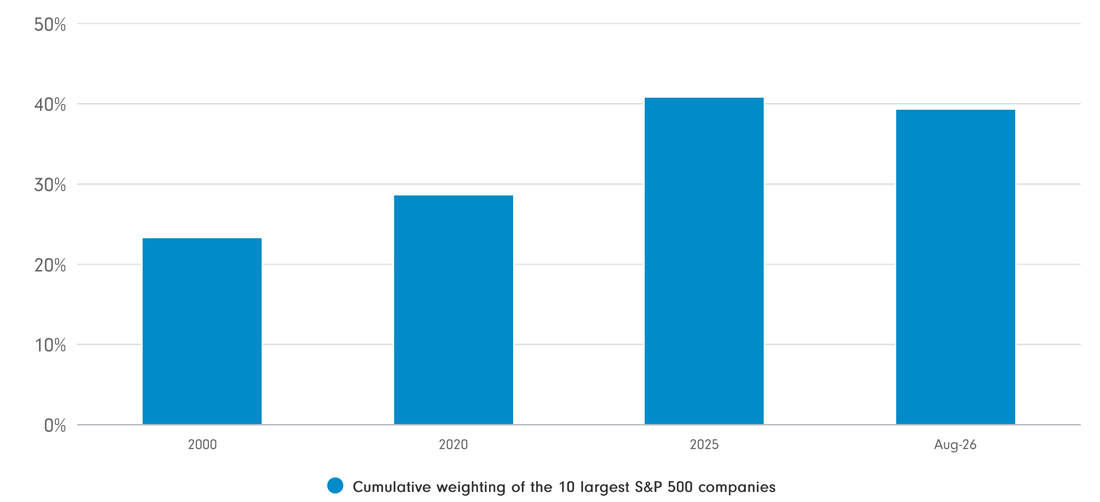
Source: Fidelity International. Data as at 31 August 2026.
For global equity investors, two distinct developments have contributed towards higher market concentration. First, the US has swelled to a significant proportion of the global market - US companies have delivered very strong earnings growth, the US has produced many of the world's most successful technology businesses, and those companies have performed exceptionally well. At the same time, the US market itself has become increasingly dominated by the Magnificent Seven and other technology stocks.
As a result, a passive investor’s ‘globally diversified portfolio’ is increasingly tilted towards the US, and concentrated around a relatively small set of companies and industries. With regards to portfolio construction and diversification, this poses the question - how many genuinely different companies does the investor own? After all, 100 companies exposed to the same economic or market drivers may provide less diversification than 30 businesses whose cash flows are driven by many different factors.
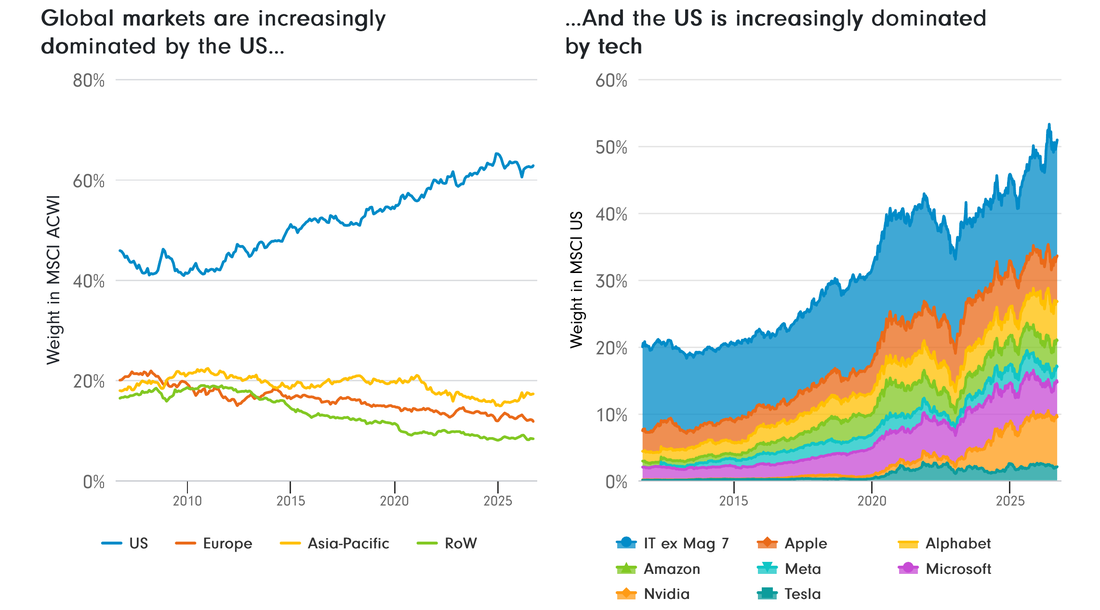
Source: Bloomberg. Data as at 31 August 2026. Past performance does not predict future returns.
We can also find signs of concentration when comparing investment styles. For a long period after the financial crisis, momentum and minimum-volatility strategies moved within a relatively contained range against one another. But since Covid, that relationship has broken out dramatically, with momentum performing extraordinarily strongly.
This shift has presented challenges for investors - including our global equity income franchise - that hold diversified portfolios of high-quality, relatively defensive businesses. Not because investee companies have stopped generating cash, or because their competitive positions have deteriorated. Rather, because the market has been prepared to pay progressively more for the characteristics at the other end of the spectrum: high growth, higher beta and strong price momentum.
Outperformance of momentum versus low volatility
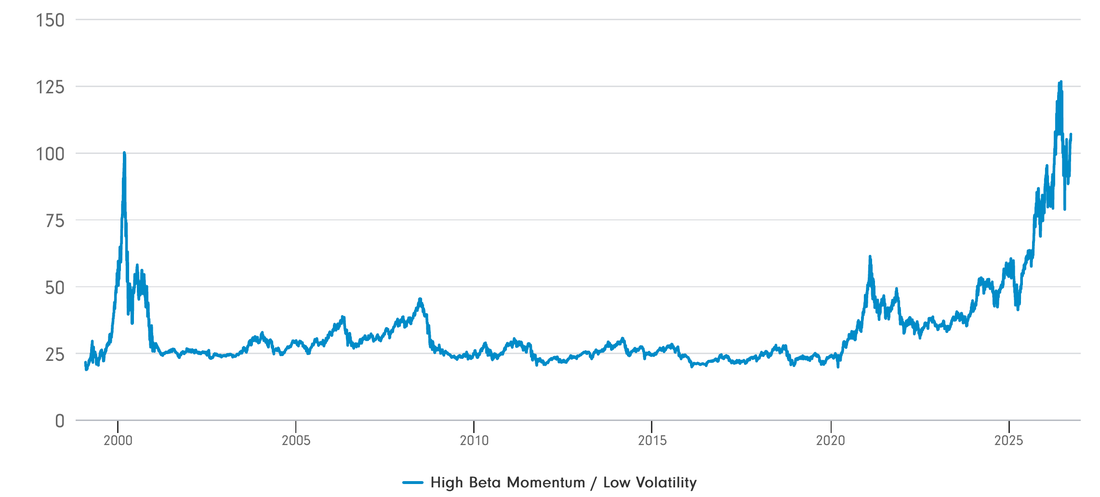
Source: Fidelity International, Bloomberg, Goldman Sachs Global Investment Research, as at 31 August 2026. S&P 500 Low Vol Index versus GS High Beta Momentum Index. Chart shown on a logarithmic scale. Momentum and low-volatility series shown for illustrative purposes only. Past performance is not a reliable indicator of future returns.
Today’s market concentration can be summarised as follows:
While we cannot forecast if or when today’s market leadership will change, it poses an important question. If an investor’s global equity portfolio is becoming increasingly dependent on a fairly narrow set of outcomes, where else can they find attractive sources of return? We believe investors can navigate the current environment by focusing on valuation, resilient cash generation, and dividends as a source of income.
Starting valuation is important because it alters the assumptions required to earn an attractive future return on investment. A premium valuation is not inherently a problem - if a company grows faster, has higher returns on capital, has a stronger competitive position or generates more reliable cash flows, it is logical for investors to pay more for it. However, the company may require sustained, strong growth, with the market continuing to award it a high multiple, to achieve attractive long-term returns. And while a cheaper company doesn’t automatically mean a better investment, a lower starting valuation provides a greater margin of safety.
Valuation discipline is a key tenet of our investment approach, and in combination with bottom-up stock picking, has led to a relative underweight to US-listed companies in our portfolios. When comparing companies globally, we often find businesses outside the US with similar quality, competitive positions and growth opportunities available at materially lower valuations. Indeed, if capital is increasingly flowing into the same subset of global equities, there can be very interesting businesses elsewhere receiving far less investor attention, trading at more attractive valuations.
In a concentrated market, dividends offer an alternative source of return that isn’t dependent on continued earnings growth or valuation multiple expansion. Indeed, while share price returns have varied wildly from year to year, the dividend component of total returns has been far more stable.
Importantly, we don’t simply seek the companies paying the highest dividend yield. Often, a very high yield means that investors expect the dividend to be cut. Instead, we aim to identify businesses with resilient cash generation, a sustainable payout and the ability to reinvest enough money to grow, while trading at an attractive valuation.
Of course, this doesn’t mean dividend-paying stocks are without risk. Dividends can be cut, or completely overwhelmed by a fall in the value of the company. However, it provides a regular, more stable component of total return that isn’t tied to the fortunes of a particular investment theme or industry.
A sustainable dividend discipline can also benefit investors in today’s markets, because it forces us to consider companies’ ability to generate cash. To pay a regular and growing dividend, companies must be capable of generating cash and reinvesting enough to sustain and grow the business, before returning the excess cash to shareholders. By reinvesting capital in the business for further growth, this can then lead to compounding of the income stream itself.
This becomes particularly valuable when the market is heavily concentrated in companies where investors are implicitly relying on a particular growth or valuation outcome. Rather than focusing on if or when market concentration will unwind, we can instead focus on the sources of return within our portfolios - including dividends.
In today’s concentrated market, we seek to build global equity income portfolios that can deliver an attractive, cross-cycle total return. Rather than relying on continued momentum within a particular investment theme or sector, our goal is to generate returns through individual stock selection, cash-flow growth, and sustainable dividends.
We also seek to deliver defensive characteristics through our portfolios. We own a collection of businesses with different geographic, sector and economic exposures relative to the wider benchmark, while seeking quality, resilient companies that can provide an element of downside protection during market downturns. Alongside our valuation discipline, we believe our diversified portfolios of quality companies, paired with our focus on a growing income stream, can help to provide investors with differentiated sources of return.
Important information
Investment objective & policy: The fund aims to achieve capital growth over the long term and provide income by investing at least 70% of its assets, in equities of companies from anywhere in the world, including emerging markets.
Marketing communication.
Fidelity Funds “FF” is an open-ended investment company (UCITS) established in Luxembourg with different classes of shares. FIL Investment Management (Luxembourg) S.à r.l. reserves the right to terminate the arrangements made for the marketing of the sub-fund and/ or its shares in accordance with Article 93a of Directive 2009/65/EC and Article 32a of Directive 2011/61/EU. Prior notice of this cessation will be made in Luxembourg.
This communication is not directed at, and must not be acted upon by persons inside the United States and is otherwise only directed at persons residing in jurisdictions where the relevant funds are authorised for distribution or where no such authorisation is required.
We recommend that you obtain detailed information before taking any investment decision. Investments should be made on the basis of the current prospectus and the KID (key information document) or KIID (key investor information document), as applicable. These documents, the current annual and semi-annual reports as well as information on investor rights are available in the languages and on the websites indicated below.
Austria: Prospectus and KID in English/German and Complaints policy in German on www.fidelity.at. Issued by FIL Investment Management (Luxembourg) S.à r.l., authorised and supervised by the CSSF (Commission de Surveillance du Secteur Financier).
Belgium: Prospectus, KID and Complaints policy in French/Dutch on www.fidelity.be. Issued by FIL Investment Management (Luxembourg) S.à r.l., authorised and supervised by the CSSF (Commission de Surveillance du Secteur Financier).
Czech Republic: Prospectus and KID in English/Czech and Complaints policy in Czech on www.fidelity.cz. Issued by FIL Investment Management (Luxembourg) S.à r.l., authorised and supervised by the CSSF (Commission de Surveillance du Secteur Financier).
Denmark: Prospectus in English, KID in English/Danish and Complaints policy in Danish on www.fidelity.dk. Issued by FIL Investment Management (Luxembourg) S.à r.l., authorised and supervised by the CSSF (Commission de Surveillance du Secteur Financier).
Finland: Prospectus in English, KID in English/Finnish and Complaints policy in Finnish on www.fidelity.fi. Issued by FIL Investment Management (Luxembourg) S.à r.l., authorised and supervised by the CSSF (Commission de Surveillance du Secteur Financier).
France: Prospectus, KID and Complaints policy in French on www.fidelity.fr. This document is available in French upon request. If you do not wish to receive documents in English dedicated to Professional, please contact your Fidelity contact. Issued in France by FIL Gestion, authorised and supervised by the AMF (Autorité des Marchés Financiers) N°GP03-004, 21 Avenue Kléber, 75116 Paris.
Germany: Prospectus in English, KID and Complaints policy in German on www.fidelity.de/anlegerinformationen, www.fidelity.de/beschwerdemanagement/ and www.fidelity.lu/complaints-handling-policy. Any performance disclosure is not compliant with German regulations regarding retail clients and must therefore not be handed out to these. Issued for German Wholesale clients by FIL Investments Services GmbH / for German Pension clients by FIL Finance Services GmbH (Kastanienhöhe 1, 61476 Kronberg im Taunus). Issued for German Institutional clients by FIL Investment Management (Luxembourg) S.à r.l., Skypark Business Center, 1 Avenue de l'Aéroport, BP 2174, L-1110 Senningerberg, Luxembourg.
Hungary: Prospectus in English, KID in English/Hungarian and Complaints policy in Hungarian on www.fidelity.co.hu. Issued by FIL Investment Management (Luxembourg) S.à r.l., authorised and supervised by the CSSF (Commission de Surveillance du Secteur Financier).
Ireland: Prospectus, KID and Complaints policy in English on www.fidelity.ie. Issued by FIL Investment Management (Luxembourg) S.à r.l., authorised and supervised by the CSSF (Commission de Surveillance du Secteur Financier).
Italy: Prospectus, KID and Complaints policy in Italian on www.fidelity-italia.it. Information is also available in Italian at Consob. Issued by FIL Investment Management (Luxembourg) S.à r.l., authorised and supervised by the CSSF (Commission de Surveillance du Secteur Financier).
Liechtenstein: Prospectus, KID and Complaints policy in English/German on www.fidelity.li. Issued by FIL Investment Management (Luxembourg) S.à r.l., authorised and supervised by the CSSF (Commission de Surveillance du Secteur Financier).
Luxembourg: Prospectus and KID in English/French/German and Complaints policy in English on www.fidelity.lu. Issued by FIL Investment Management (Luxembourg) S.à r.l., authorised and supervised by the CSSF (Commission de Surveillance du Secteur Financier).
Malta: Prospectus, KID and Complaints policy in English on www.fidelity.com.mt and from BOV Asset Management Limited (which is licensed by the Malta Financial Services Authority). The Fund is promoted in Malta by BOV Asset Management Limited in terms of the EU UCITS Directive; the Investment Services Act, Chapter 370 of the Laws of Malta; and the Investment Services Act (Marketing of UCITS) Regulation, Subsidiary Legislation 370.18 of the Laws of Malta. Issued by FIL Investment Management (Luxembourg) S.à r.l., authorised and supervised by the CSSF (Commission de Surveillance du Secteur Financier).
Netherlands: Prospectus, KID and Complaints policy in Dutch on www.fidelity.nl. Issued by FIL Investment Management (Luxembourg) S.à r.l., authorised and supervised by the CSSF (Commission de Surveillance du Secteur Financier).
Norway: Prospectus in English, KID in English/Norwegian and Complaints policy in Norwegian on www.fidelity.no. Issued by FIL Investment Management (Luxembourg) S.à r.l., authorised and supervised by the CSSF (Commission de Surveillance du Secteur Financier).
Poland: Prospectus, KID, Additional Information for Investors in English/Polish and Complaints policy in Polish on www.fidelity.pl and from the fund’s representative office in Poland. This material does not constitute a recommendation within the meaning of the Regulation of the Polish Minister of Finance Regarding Information Constituting Recommendations Concerning Financial Instruments or Issuers Thereof dated October 19, 2005. No statements or representations made in this document are legally binding on Fidelity or the recipient and not constitute an offer within the meaning of the Polish Civil Code Act of 23 April 1964. Issued by FIL Investment Management (Luxembourg) S.à r.l., authorised and supervised by the CSSF (Commission de Surveillance du Secteur Financier).
Portugal: Prospectus in English, KID and Complaints policy in Portuguese on www.fidelity.pt. Fidelity Funds is registered with the CMVM and the legal documents can be obtained from locally authorised distributors. Issued by FIL Investment Management (Luxembourg) S.à r.l., authorised and supervised by the CSSF (Commission de Surveillance du Secteur Financier).
Slovakia: Prospectus in English, KID in English/Slovakian and Complaints policy in Slovakian on www.fidelity.sk. Issued by FIL Investment Management (Luxembourg) S.à r.l., authorised and supervised by the CSSF (Commission de Surveillance du Secteur Financier).
Spain: Prospectus and KID in English/Spanish and Complaints policy in Spanish on www.fondosfidelity.es. The distributing and depositary entities are, respectively, FIL Investment Management (Luxembourg) S.à r.l. and Brown Brothers Harriman (Luxembourg) S.C.A. Fidelity Funds and FAST are registered for marketing in Spain in the register of Foreign Collective Investment Undertakings of the CNMV under registration numbers 124 and 649 respectively, where detailed information on the local distributors can be obtained. Issued by FIL Investment Management (Luxembourg) S.à r.l., authorised and supervised by the CSSF (Commission de Surveillance du Secteur Financier).
Sweden: Prospectus in English, KID in English/Swedish and Complaints policy in Swedish on www.fidelity.se. Issued by FIL Investment Management (Luxembourg) S.à r.l., authorised and supervised by the CSSF (Commission de Surveillance du Secteur Financier).
Switzerland: Prospectus and KID in English/German/French and Complaints policy in German/English on www.fidelity.ch and from the representative and paying agent in Switzerland, BNP Paribas, Paris, succursale de Zurich, Selnaustrasse 16, 8002 Zurich. Fidelity undertakes the financial services of purchasing and/or selling financial instruments within the meaning of the Financial Services Act (FinSA). Fidelity is not required to assess the appropriateness and suitability under FinSA. The information provided constitutes an advertisement. Issued by FIL Investment Switzerland AG.
UK: The Key Investor Information Document (KIID) is available in English and can be obtained from our website at www.fidelityinternational.com. The Prospectus may also be obtained from Fidelity. Issued by FIL Pensions Management. Authorised and regulated by the Financial Conduct Authority.

GCT261104EUR