

13 Aug 2026
The repricing of fixed income markets, resilient corporate fundamentals and increasing differentiation across issuers are improving the case for selected areas of the market, particularly investment grade credit. Against a backdrop of ongoing macroeconomic uncertainty and heightened geopolitical tensions, Fidelity’s active Fixed Income ETF team examines why investors are increasingly turning to active, research-led credit selection through transparent, cost-efficient ETF solutions.
Fixed income has re-established its position as a core allocation within diversified portfolios, offering attractive income potential alongside valuable diversification benefits. As investors continue to navigate an environment characterised by macroeconomic uncertainty, evolving monetary policy, and heightened geopolitical tensions, investment grade corporate bonds remain well positioned to deliver attractive risk-adjusted returns.
Strong equity market performance over recent years has reduced the relative appeal of fixed income for many investors. However, in recent months, higher starting yields have started to improve the long-term return potential of fixed income, while resilient corporate fundamentals continue to support the case for investment grade credit.
Government debt levels have increased materially across developed markets since the Global Financial Crisis as fiscal borrowing has risen. By contrast, investment grade corporate balance sheets have generally remained resilient. Combined with today's higher yield environment, this has created an attractive combination of resilient fundamentals and compelling income potential, reinforcing the role of investment grade corporate bonds as a strategic core allocation within diversified portfolios.
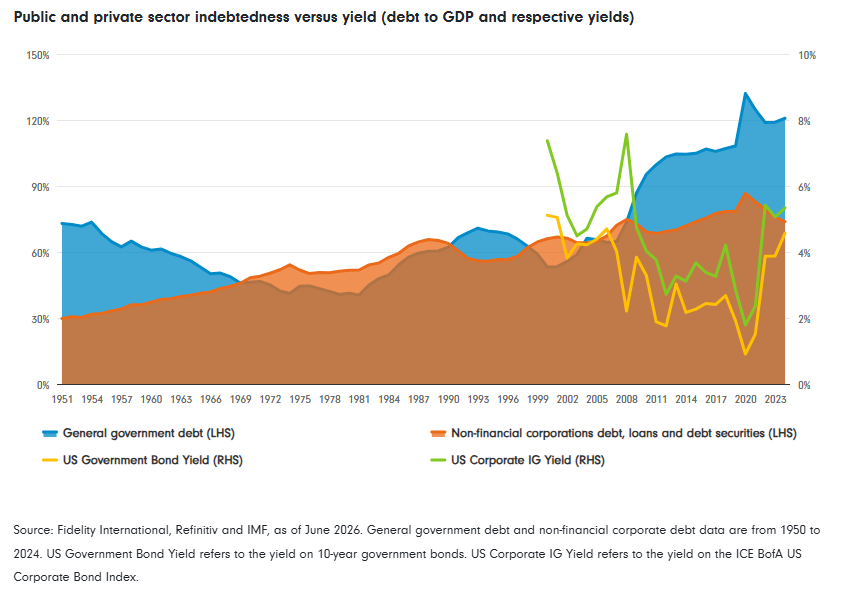
Additionally, investment grade corporate debt offers an attractive avenue of diversification for investor portfolios. Corporate bonds tend to have low or potentially even negative correlations to the corresponding building blocks within equity markets, enhancing their attraction at a time when investors have allocated heavily to equities due to AI-driven exuberance and gains.
Credit markets are broad and diverse, with issuers varying significantly in their fundamentals, valuations and credit profiles. Even within the investment grade universe, issuers with similar credit ratings can exhibit materially different risk and return characteristics. In today's environment of relatively tight credit spreads, disciplined issuer selection becomes increasingly important in identifying attractive relative value opportunities.
Passive index trackers can play a valuable role in providing efficient, low-cost access to broad market beta, but by design they aim to deliver benchmark returns before fees and do not differentiate between issuers within the index. For investors seeking to enhance core allocations or generate incremental returns, passive building blocks alone may therefore be insufficient.
Active fixed income ETFs address this by systematically integrating research insights into security selection within a benchmark-aware risk framework. By maintaining close alignment to benchmark characteristics while allowing for differentiated positioning at the issuer level, these strategies provide investors with flexible, transparent and cost-efficient access to active credit management. At a time when allocations to fixed income are rising, exposure to active fixed income strategies can complement passive allocations and enhance income, diversification and portfolio stability outcomes.
Fidelity's range of Fixed Income Research Enhanced ETFs provide investors with access to active investment grade credit strategies designed to generate excess returns primarily through disciplined issuer selection, rather than relying on macro views or duration positioning. This allows investors to enhance core credit allocations while maintaining benchmark-like portfolio characteristics.
The investment process combines proprietary quantitative models with Fidelity's extensive fundamental credit research capabilities to assess relative value opportunities consistently across market cycles. Managed by an experienced Systematic Fixed Income team and delivered through transparent, liquid and cost-efficient ETFs, the strategies provide investors with an efficient way to access disciplined active credit management.
Fidelity Fixed Income Research Enhanced ETFs
Discover more on the Fidelity Fixed Income Research Enhanced ETFs range and how you can access enhanced beta via sustainable and fundamental active research.