

29 Jul 2026
Recent moves in oil prices have reinforced the uncertainty surrounding the inflation outlook and the path for interest rates. Resilient US growth, uncertain Fed signals and persistent regional inflation pressures also continue to suggest the outlook for rates is far from clear. Mike Riddell, Portfolio Manager of the Fidelity Strategic Bond Fund, discusses the key drivers shaping rates markets and where he sees the risks and opportunities for bond investors.
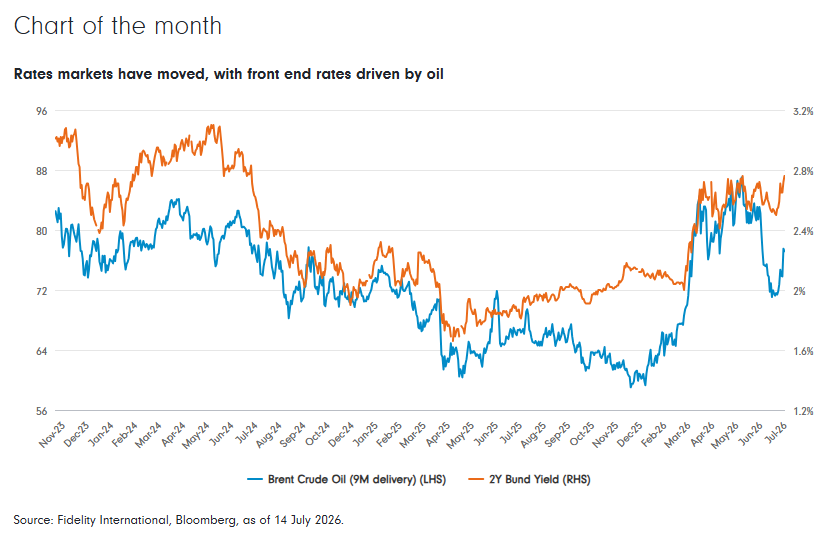
We moved to a long overall duration as falling oil weakened the case for further hikes an softer data increased the risk of a rates rally, while keeping implementation selective.
Duration was initially trimmed after the rally, mainly through Australian and UK rates, before being rebuilt across US, European, Australian, Korean and Philippine rates. In the US, the duration underweight was reduced as elevated front-end rates and short positioning increased sensitivity to softer data.
EM local rates were rotated, with Peru exited, Mexico and Brazil trimmed, and Paraguay added selectively.
We remain long inflation, as markets still appear too relaxed on second-round effects and the risk that inflation proves stickier than expected. Lower oil and softer agricultural prices should help near-term prints, but this does not remove the case for retaining inflation protection.
Inflation exposure remains concentrated mainly in shorter-dated inflation swaps. This reflects a more front-end-focused inflation view, where near-term headline relief can coexist with persistent underlying inflation risks.
We recently trimmed short-dated US real-yield exposure, using headline-driven price action to take some risk off after a favourable move.
Currency positioning remains selective rather than reflecting broad emerging market exposure. Profits were taken on long positions in the Peruvian sol (PEN) and Colombian peso (COP) following strong rallies, with the latter also facing a more challenging terms of trade outlook as lower oil prices weighed on Colombia's export outlook.
In Asia, short positions in the Thai baht (THB) and Philippine peso (PHP) were reduced, while a long Japanese yen (JPY) versus Chinese renminbi (CNH) position was initiated, reflecting the renminbi's resilience despite weak Chinese economic data and the yen's limited response to lower energy prices and the global rates rally.
Credit remains unattractive on valuation grounds. Global IG corporate spreads are close to post-2010 tights, having been tighter only around 2% of the time, leaving limited cushion if growth weakens, inflation proves sticky or risk sentiment deteriorates.
Given this backdrop, we continue to avoid adding broad credit risk without clearer compensation for the macro risks.
In June 2026, the fund delivered a gross return of 0.47%, compared with 0.24% for the benchmark, generating 0.23% of alpha over the month. The fund’s outperformance was driven by favourable rates positioning, partially offset by inflation positioning, while yield, currency and credit positioning also detracted modestly.
Rates: Rates positioning contributed significantly to outperformance. Long positions in AUD, NOK, COP, MXN, PEN and PHP rates, alongside a short JPY position, added significant value. This was partially offset by a short USD rates position, while moderate short positions in EUR and THB also detracted following the recent rally, as markets appeared too quick to price in geopolitical relief.
Inflation: The long US inflation position detracted modestly from performance as lower oil prices and easing geopolitical tensions reduced market-implied inflation expectations, causing US inflation breakevens to narrow.
Currencies: Currency positioning detracted modestly, led by long positions in NOK, CHF, BRL and CLP. This was partially offset by positive contributions from short positions in GBP and THB, alongside a long position in COP.
Credit: The short position in European high yield credit detracted as credit spreads tightened amid improving risk sentiment following the easing of geopolitical tensions.
Past performance does not predict future returns
| Standard period fund performance* (GBP, gross of fees) | 1 month | 3 months | 6 months | YTD |
|---|---|---|---|---|
|
Fidelity Strategic Bond* |
0.5% |
1.8% |
3.9% |
5.3% |
|
Index** |
0.4% |
1.3% |
1.1% |
3.1% |

Source: Fidelity International, Bloomberg, 30 June 2026. *Performance reflects W Income shares (gross of fees). Ongoing Charges Figure of 0.62% per year applies. **Index and relative returns reflect the Strategic Asset Allocation Blend (ICE BofA Q880 Custom Index) until 01 December 2024 and thereafter Bloomberg Global Aggregate Index Total Return Index Hedged to GBP. Fund inception: 18 April 2005. Performance data is quoted at the fund's official valuation point. Please also note that numbers may not sum exactly to totals shown due to the rounding of figures.
Important information
This information is for investment professionals only and should not be relied upon by private investors. Past performance is not a reliable indicator of future returns. Investors should note that the views expressed may no longer be current and may have already been acted upon. Changes in currency exchange rates may affect the value of investments in overseas markets. Fidelity’s range of fixed income funds can use financial derivative instruments for investment purposes, which may expose them to a higher degree of risk and can cause investments to experience larger than average price fluctuations. The value of bonds is influenced by movements in interest rates and bond yields. If interest rates and so bond yields rise, bond prices tend to fall, and vice versa. The price of bonds with a longer lifetime until maturity is generally more sensitive to interest rate movements than those with a shorter lifetime to maturity. The risk of default is based on the issuers ability to make interest payments and to repay the loan at maturity. Default risk may therefore vary between government issuers as well as between different corporate issuers. Due to the greater possibility of default, an investment in a corporate bond is generally less secure than an investment in government bonds. Reference in this document to specific securities should not be interpreted as a recommendation to buy or sell these securities and is only included for illustration purposes.
UK: The Key Investor Information Document (KIID) is available in English and can be obtained from our website at www.fidelityinternational.com. The Prospectus may also be obtained from Fidelity. Issued by FIL Pensions Management. Authorised and regulated by the Financial Conduct Authority.
FIPM: 10716