

28 Jul 2026
Our latest Analyst Survey, a visit to Silicon Valley, and research from Fidelity’s multi-asset and macro teams offer signs of where next for the AI revolution, both for businesses to invest in and the months ahead in markets.
Key points
Over the space of four days in June, we met 21 companies across Silicon Valley, as part of a regular trip we make to gauge the mood at the epicentre of tech and the AI trade. Last year it was bullish; this time it was even more so. Every company out there is convinced that they are going to be one of the handful of eventual AI winners.
In reality, that can't be true for all of them. We were on the lookout for clues telling us where the market is heading, and which companies are best positioned to capitalise. At another important moment in the development and spread of AI, we learned three key things.
1: ‘Valuemaxxing’ has replaced ‘tokenmaxxing’
A year ago, you would still hear questions about whether businesses would fully embrace AI, and how long that might take. Many companies encouraged employees to find ways of using the latest models. The term ‘tokenmaxxing’ entered popular use to describe the practice of using AI as much as possible.
Listen to our discussion on the latest Fidelity Answers podcast.
Today, tokenmaxxing is out and ‘valuemaxxing’ is in. Companies are seeking ways to optimise their use of AI and get as much bang for their budget as they can, for example by using simpler models for simple tasks rather than reaching for the latest frontier model to do something routine – the AI equivalent of driving an F1 car for your office commute and then complaining about fuel costs.
The pessimistic interpretation of this development is that companies are getting spooked by the true cost of AI compute as what they pay moves closer to what it costs the tech companies to deliver each token.
However, in San Francisco we spoke to the CFO of one company that’s been in the headlines for heavily overrunning its AI budget. Behind closed doors we heard a very different story: token spend is actually still in single digits as a percentage of overall spend. When you meet the companies and when you look at the hard numbers, it’s clear to us there remains plenty of room to grow.
Our evaluation is that what valuemaxxing really means is businesses can do more with the same. It’s also making them more thoughtful about how they use AI. That same company has put a $1,500 monthly cap on each employee’s AI spend. If anyone wants to go above that, they have to make a business case. The vast majority of such requests get approved.
2: AI use is spreading through organisations
Being able to do more with the same, while having visibility and control of costs, creates a solid foundation for ‘diffusion’. This is the process by which a company adopts a new technology and it spreads through the organisation.
In the last 12 months we’ve seen this process pick up. A year ago, it was common for 1 per cent of a business’s employees to dominate spending on tokens. Token use has since spread from those early adopters to entire IT and coding functions.
The next step is to diffuse the coding tools to the broader workforce, which will take longer.
In the most recent survey of almost 100 analysts at Fidelity we asked: ‘Is AI affecting decisions around workforce sizes at your companies?’ The ‘More with same’ answer was the most popular across our research team (46 per cent of all survey respondents), which aligns with what we saw in Silicon Valley.
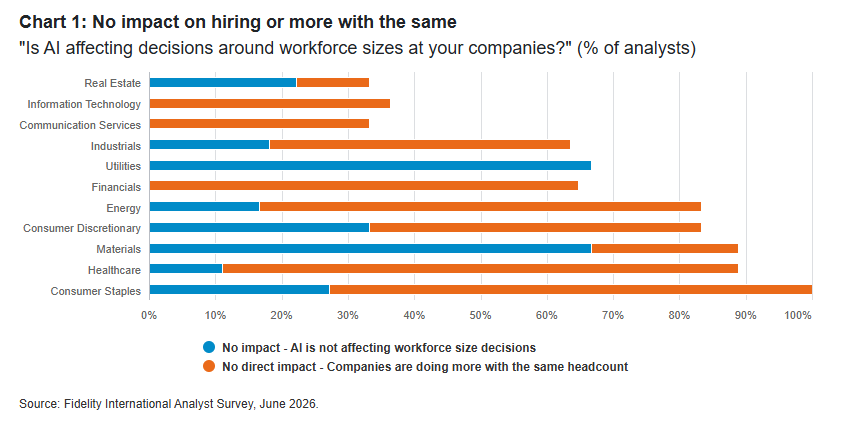
There are also signs that AI is having a direct impact on headcounts. Going by analysts’ responses this is often happening at the margins, or by cutting hiring plans or letting people leave organically without replacing them.
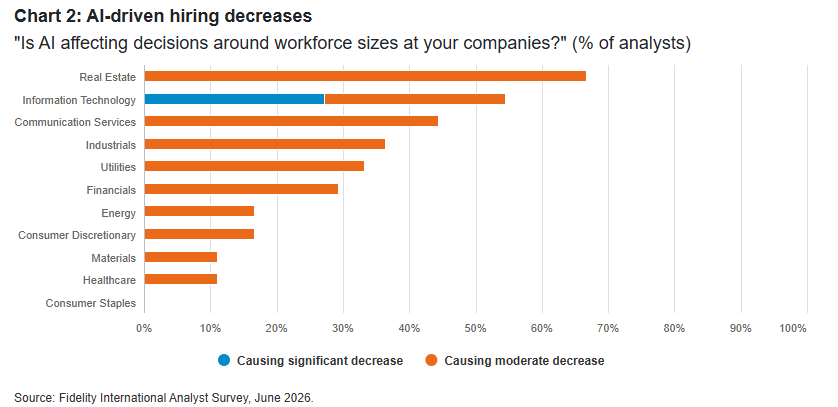
As use cases increase, we can expect the ‘more with same and more with less’ dynamic to spread. We saw several interesting examples in Silicon Valley where AI is being deployed in the physical world. One was law enforcement, which is using bodycams and AI to monitor what happens on the street and then write a draft for the related paperwork, allowing officers to spend more time out in the field.
3: Hyperscalers are starting to see revenues come through
As physical and non-physical AI use cases grow, all that data has to go somewhere, be stored somewhere, and processed somewhere. The memory story is well known, but that part of the market looks set to remain tight for the foreseeable future.
Perhaps more interesting is the pick-up we’re seeing in revenue among hyperscalers, which continue to make headlines about the scale of their capex, rather than the money they’re bringing in.
For most of this year the likes of Microsoft, Meta, and Amazon have struggled in the public markets compared to chip companies. This is despite showing revenue growth, including 30 per cent year-on-year growth for Meta in the first quarter of this year.
The issue is this: will returns hold as hyperscaler spending gets larger? That’s a challenge because the target gets bigger; hyperscalers are on a hamster wheel. But so far, things look good, given the sizeable lag between the capex and its returns. The revenue growth we’re seeing this year reflects last year’s capex, or possibly that of earlier years. Viewed on that basis, return on investments are encouraging.
Hyperscalers have accelerated capex considerably to meet demand for coding and agentic AI use cases. And while our visibility on the demand for these models at companies like Open AI and Anthropic is limited, there are positive signs. The hyperscalers are the providers of the compute those model companies need, and their decisions on chips and investment are based on what they’re being asked to support. We know demand at the chip level is strong. We think the next shoe to drop is businesses accelerating AI use cases, including coding and agents, and in turn that will come back to the hyperscalers as further revenue growth.
Investment implications
A new paper from our Global Macro & Strategic Asset Allocation Team also backs up the long-term outlook here. Our modelling suggests that AI will deliver an extra half a percentage point on average global growth versus previous decades and that for the immediate future there’s further to run in the boom that’s providing the energy and other infrastructure for the technology.
From our perspective, a lot hinges on how much those commercial revenues grow. Hyperscalers have so far funded the investment spending through organic free cashflow (FCF). They haven’t put their balance sheets in jeopardy. But with the extraordinary pace of the past year they have fully reduced FCF. The market is looking to see if there’s an inflection point, where returns are sufficient for that indicator to start bottoming out.
If investors can get line-of sight on FCF improving – not returning to historic levels, just starting to improve – it could drive a big re-rating of these companies.
This in turn rests on how broadly and how quickly businesses adopt AI. From what we heard in Silicon Valley, and from what our research colleagues across other sectors are also seeing, the ‘more with same and more with less’ approach is starting to spread. Valuemaxxing shows businesses see AI as an integral part of their future, no longer a blue-sky curiosity.
Looked at one way, this story still has a long way to run, as AI diffuses through businesses, through societies, and across the thresholds between virtual and physical worlds as interfaces and robotics advance.
Looked at another way, it’s the latest chapter in a centuries-old tale of disruptive technologies that come along, raise more questions than they can initially answer, before leaving most of them moot as the world is changed utterly.
Important Information
This material is for Institutional Investors and Investment Professionals only, and should not be distributed to the general public or be relied upon by private investors.
This material is provided for information purposes only and is intended only for the person or entity to which it is sent. It must not be reproduced or circulated to any other party without prior permission of Fidelity.
This material does not constitute a distribution, an offer or solicitation to engage the investment management services of Fidelity, or an offer to buy or sell or the solicitation of any offer to buy or sell any securities in any jurisdiction or country where such distribution or offer is not authorised or would be contrary to local laws or regulations. Fidelity makes no representations that the contents are appropriate for use in all locations or that the transactions or services discussed are available or appropriate for sale or use in all jurisdictions or countries or by all investors or counterparties.
This communication is not directed at, and must not be acted on by persons inside the United States. All persons and entities accessing the information do so on their own initiative and are responsible for compliance with applicable local laws and regulations and should consult their professional advisers. This material may contain materials from third-parties which are supplied by companies that are not affiliated with any Fidelity entity (Third-Party Content). Fidelity has not been involved in the preparation, adoption or editing of such third-party materials and does not explicitly or implicitly endorse or approve such content. Fidelity International is not responsible for any errors or omissions relating to specific information provided by third parties.
Fidelity International refers to the group of companies which form the global investment management organization that provides products and services in designated jurisdictions outside of North America. Fidelity, Fidelity International, the Fidelity International logo and F symbol are trademarks of FIL Limited. Fidelity only offers information on products and services and does not provide investment advice based on individual circumstances, other than when specifically stipulated by an appropriately authorised firm, in a formal communication with the client.